

Understanding What Your Yacht Is Actually Worth
The actual cash value of my boat is a term that appears in many marine insurance policies, but it’s often misunderstood until a claim is filed. Here’s what you need to know:
Actual Cash Value (ACV) is the current market value of your vessel at the time of a loss, accounting for depreciation, wear and tear, and overall condition. In a total loss, an ACV policy pays what your boat is worth today—not what you paid for it, and not necessarily what it would cost to replace it with a comparable vessel.
Key differences from Agreed Value:
- ACV: Payout based on depreciated market value at time of loss
- Agreed Value: Payout based on a fixed amount agreed upon when the policy is written
- Impact: ACV claims often result in lower payouts, especially for older vessels or those with significant use
Most marine insurance problems don’t appear when a policy is bound—they appear when something goes wrong. A common and costly misunderstanding revolves around how a policy values a vessel at the time of a loss. Many yacht owners assume their coverage will provide enough to replace their vessel, only to find that depreciation and market conditions have created a significant gap between the insurance payout and the actual cost of acquiring a comparable boat.
This article will clarify what Actual Cash Value means for a yacht owner, how it’s determined by insurers, and how it compares to other valuation methods. Understanding these distinctions can help you make more informed decisions about your marine insurance coverage and avoid unexpected financial shortfalls during a claim.
I’m Eric Fisher, and over the past decade in marine insurance I’ve seen how valuation methods directly impact claim outcomes, particularly when yacht owners are trying to understand the actual cash value of my boat and whether their policy will adequately protect their investment. This guide breaks down the factors that determine ACV and explains when it may or may not be the right approach for your situation.
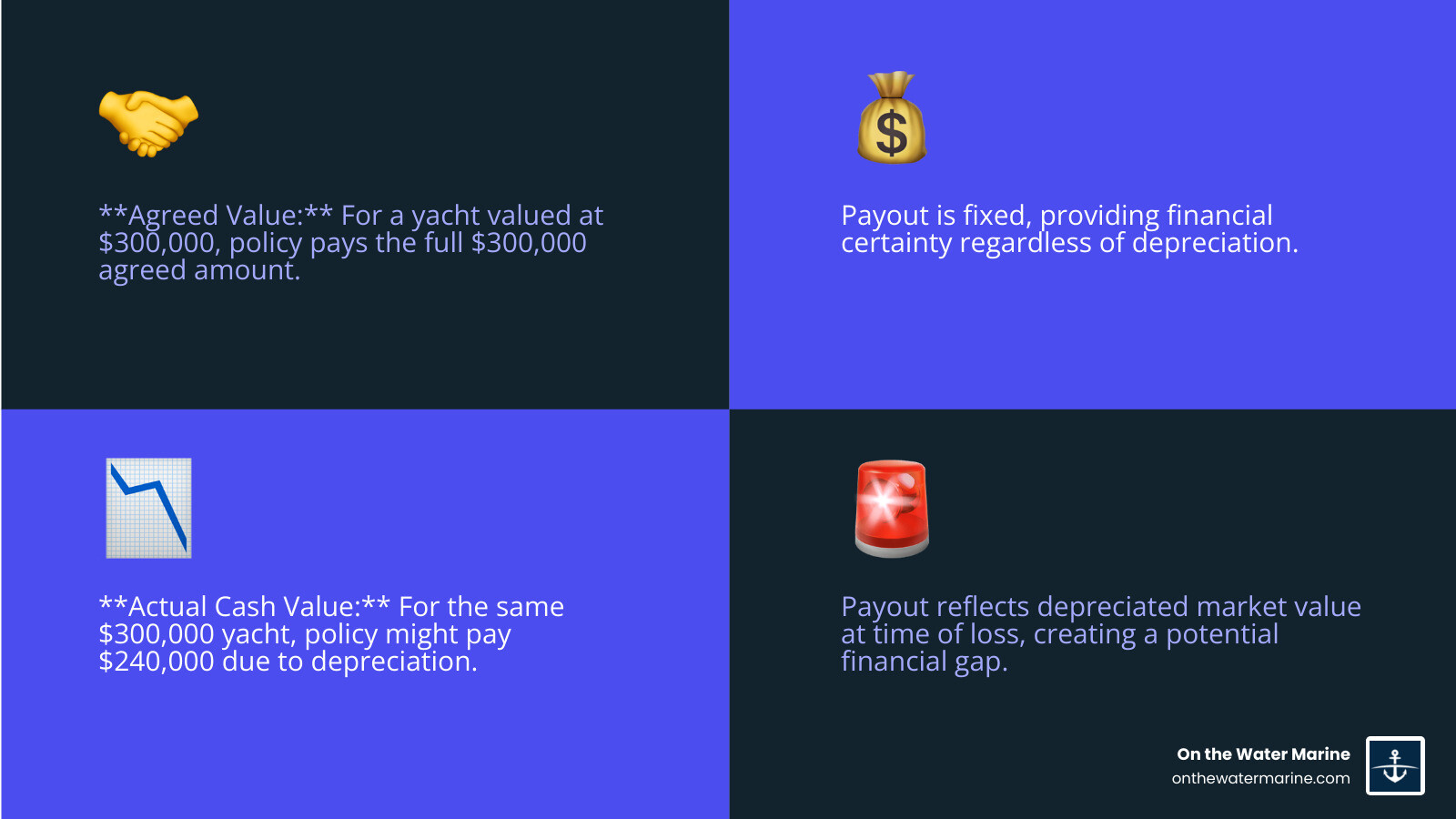
Understanding the Two Primary Valuation Methods: Actual Cash Value vs. Agreed Value
When insuring a yacht, one of the most critical decisions involves selecting the valuation method for your policy. This choice directly impacts the amount you may receive in the event of a total loss. The two primary methods we encounter are Actual Cash Value (ACV) and Agreed Value. Understanding the nuances of each is fundamental for any serious marine buyer.
An Agreed Value policy is often preferred by owners of high-value vessels. With this type of policy, your insurance provider agrees to honor a specific value for your boat at the time the policy is written. If your vessel becomes a total loss, you generally receive that pre-determined, agreed-upon amount, less any applicable deductible. This approach provides a clear expectation and a degree of certainty for a payout.
Conversely, an Actual Cash Value (ACV) policy pays you the replacement cost of the boat at the time of the loss, but it significantly factors in depreciation, damage, and wear and tear. This means the payout reflects the boat’s current market value, not necessarily its original purchase price or what it would cost to replace it with a brand-new vessel. An ACV policy only pays up to the value of the boat at the time it was a total loss.
The key difference lies in when the value is determined. Agreed Value sets the amount at the policy’s inception, offering a fixed sum. ACV, however, assesses the value at the moment of the loss, which, due to depreciation, is almost always a lower figure than the original purchase price or the cost of a new replacement. This distinction can lead to substantial differences in claim payouts, especially for older vessels or those that have seen significant use.
Here’s a comparison to help clarify these two critical valuation methods:
| Feature | Agreed Value | Actual Cash Value (ACV) |
|---|---|---|
| Valuation Basis | Fixed amount agreed upon at policy inception | Current market value at the time of loss (depreciated) |
| Payout in Total Loss | Guaranteed, pre-determined sum (less deductible) | Depreciated value of the vessel |
| Premium Influence | Typically higher due to fixed payout certainty | Generally lower, reflecting the depreciated payout |
| Common Scenarios | Newer vessels, high-value yachts, peace of mind | Older vessels, basic coverage needs, cost-saving focus |
For a more in-depth look at these differences, you can explore More on the differences between Agreed Value and Actual Cash Value Boat Insurance.
How Insurers Determine the Actual Cash Value of My Boat
When it comes to an ACV policy, the concept of depreciation is central to how insurers calculate the actual cash value of my boat. Unlike an Agreed Value policy where the payout is fixed, an ACV policy requires an assessment of your vessel’s market value at the very moment of a loss. This assessment considers a range of factors that contribute to the boat’s current worth.
Insurers will typically assess the market value by looking at what similar boats are currently selling for. This market value assessment is not just about the raw age of the vessel; it also involves a detailed evaluation of its overall condition. The role of wear and tear is significant here. Any signs of deterioration, deferred maintenance, or general aging will be factored into the final ACV calculation.
To aid in this determination, especially for smaller vessels or components, insurers may refer to industry standard guides. These can include publications such as the N.A.D.A. book, BUC Used Price Guide, or the ABOS Marine Blue Book. While these guides provide a baseline, they are often supplemented by other factors specific to your vessel.
Understanding these valuation methods is key to managing your expectations regarding potential payouts. For a deeper dive into how market value relates to replacement costs, you can read more at What is the difference between Replacement Cost and Market Value?.
What factors influence a boat’s ACV?
Several elements combine to shape the actual cash value of my boat. These factors help paint a comprehensive picture of your vessel’s market worth at any given time:
- Age: This is often the most significant factor. Boats, like cars, generally depreciate over time. The sharpest drops in value typically occur in the first few years. For instance, a boat might depreciate 10-20% after one year and 20-30% after five years. However, this rate can slow down significantly after ten years, where condition and maintenance history become even more paramount.
- Overall Condition: A yacht’s physical state is critical. A well-maintained exterior and hull, an engine with low hours and a documented service record, and a clean, functional interior all contribute positively to fair market value. Conversely, issues like structural damage, neglected upkeep, or excessive wear and tear can significantly reduce the ACV.
- Vessel Type: Not all boats depreciate at the same rate. Work craft, such as certain fishing or pontoon boats, may depreciate faster than leisure or luxury yachts. The market demand for specific types of vessels can also play a role.
- Brand and Model Reputation: The reputation of the manufacturer and the specific model can influence resale figures. Brands known for quality, innovation, and customer satisfaction often retain higher values. For example, a Boston Whaler model, known for its “unsinkable” hull, may hold its value differently than other brands.
- Upgrades and Customizations: While some upgrades can improve value, not all do. Modifications that demonstrably increase safety, usability, reliability, or performance (e.g., updated navigation systems, a newer, efficient engine, well-executed custom features) are more likely to add to the ACV. Poorly executed or purely aesthetic customizations, however, can sometimes detract from the value.
- Documented Maintenance History: A comprehensive and accurate record of all maintenance, repairs, and service performed on your vessel can significantly improve its market appeal and, consequently, its ACV. It provides assurance to potential buyers and insurers that the boat has been well cared for.
All these factors contribute to Understanding a boat’s fair market value and are carefully weighed when determining an ACV payout.
How does depreciation impact the actual cash value of my boat?
Depreciation is the silent force that continuously reshapes the actual cash value of my boat. It represents the loss of value over time due to age, wear, and obsolescence. For marine insurance, understanding its impact is crucial.
For new vessels, the initial depreciation curve is typically steep. A significant portion of a boat’s value can diminish in its first few years. This is a common pattern across many types of assets, where the value drops sharply once an item moves from “new” to “used.”
However, for older, well-maintained yachts, the depreciation tends to slow down. After perhaps ten years, the rate of depreciation becomes less aggressive. At this stage, the vessel’s ongoing condition, meticulous maintenance, and any significant upgrades become proportionally more important in sustaining its value than its mere age. A classic yacht that has been lovingly cared for may hold its value remarkably well, even if it is decades old.
It is also important to consider component-specific depreciation. Many ACV policies apply separate depreciation schedules to various parts of your vessel. For example, items like sails, canvas, carpeting, cushions, fabric, outboard motors, outdrives, and generators may be subject to depreciation calculations independent of the hull. In some policies, these components may even have a minimum residual value, meaning they will not depreciate below a certain percentage (e.g., 20%) of their original value, regardless of their age or condition. This means that even if a component is very old, it still retains some baseline value for claim purposes.
The Role of a Marine Survey in Establishing Value
When seeking an accurate valuation for your yacht, especially for insurance purposes, relying solely on online estimators can be a risky endeavor. While these tools may offer general estimates for common boat types, they often fall short for high-value vessels and complex marine assets. This is where the professional appraisal of a marine surveyor becomes indispensable.
A marine surveyor conducts a thorough Condition and Valuation (C&V) survey, which is far more comprehensive than any automated online tool. A surveyor will consider your boat’s unique construction, its current condition, and all its specific equipment. They carefully inspect your boat from stem to stern, examining the hull for structural integrity, checking machinery for operational soundness, and assessing the overall seaworthiness of the vessel. This hands-on inspection provides an unbiased, expert opinion on your boat’s true market value, accounting for details that no algorithm can capture. This detailed examination helps to establish the boat’s seaworthiness and its value.

How to find a qualified marine surveyor
Finding a qualified marine surveyor is paramount for an accurate and unbiased appraisal. It is not enough to simply find someone who claims to be a surveyor. We always recommend ensuring they are accredited or certified by professionally recognized organizations.
These organizations uphold rigorous standards for expertise, ethics, and ongoing professional development. Two prominent resources for finding such professionals include the National Association of Marine Surveyors (NAMS) and the American Boat and Yacht Council (ABYC). Surveyors affiliated with these bodies have demonstrated a high level of competence and adhere to industry best practices. Vetting their credentials carefully ensures you receive a credible and defensible valuation.
Why online valuation tools are often insufficient for yachts
While convenient, online valuation tools are often insufficient for accurately determining the value of a yacht, particularly those 35 feet and above. These tools face significant data limitations for unique vessels. Unlike cars, where millions of identical models are sold annually, yachts are often customized, maintained differently, and sold in a far less uniform market. This makes it difficult to obtain sufficient, reliable transaction data for accurate valuation, as even Kelley Blue Book does not offer boat values for this reason.
Online estimators inherently cannot account for the physical condition of your vessel, the quality of its maintenance, or the specifics of its custom features. A boat’s value is highly variable due to factors like maintenance history, climate exposure (saltwater versus freshwater use), storage conditions, and the extent of customization. These critical nuances are simply beyond the scope of an automated tool.
Furthermore, we often see websites that use terms like “Blue Book” or “KBB Boat Book” in their titles, which can mislead users into thinking they offer official Kelley Blue Book boat values. This is not the case, and such sites may provide inaccurate or generalized information. For high-value assets like yachts, the need for precision when establishing value for insurance purposes is paramount. Relying on generalized or potentially misleading online estimates can lead to significant financial shortfalls if a claim arises.
Policy Implications of Actual Cash Value Coverage
The choice of an Actual Cash Value policy carries distinct implications for how claims are processed and the financial outcome you might expect. It is crucial to understand that your policy language dictates claim payments, and ACV coverage is structured to reflect the depreciated value at the time of loss, not the original purchase price or replacement cost.
This valuation method can lead to potential financial gaps. For instance, an ACV policy only pays up to the value of the boat at the time it was a total loss. If you were to purchase new items to replace those lost or damaged under an ACV policy, you would likely be responsible for the difference between the insurance payout and the cost of the brand-new item. This means you could be on the hook for a significant portion of the replacement cost yourself.
Navigating these policy nuances requires a clear understanding of your coverage terms. For a broader perspective on marine insurance concepts, we encourage you to review Demystifying Boat Insurance.
What happens in a total loss with an ACV policy?
In the unfortunate event of a total loss under an ACV policy, the process for payout calculation focuses on determining your vessel’s market value immediately before the incident. The insurer will typically reimburse you for the actual cash value—that is, the boat’s current market value, not its replacement value—at the time of the loss.
This approach means that the payout will account for depreciation, wear and tear, and the overall condition of your yacht. If your vessel, for example, was purchased several years ago, its ACV payout would likely be considerably less than what you originally paid. This can create a significant financial gap between the insurance payout and the actual cost to acquire a comparable vessel in today’s market. We have seen instances where market fluctuations, such as periods of high demand and limited supply, can even cause boat values to increase, but an ACV policy would still adhere to its depreciated calculation, potentially leaving a gap if your vessel’s market value has outpaced its depreciated value.
How does an ACV policy handle partial losses and equipment?
For partial losses under an ACV policy, the calculation becomes more granular. When repairs or replacements are needed, the insurer will typically pay the reasonable cost of those repairs or replacements, in accordance with quality marine repair practice, but often less depreciation.
This depreciation can apply to specific components rather than just the entire vessel. Items commonly subject to component-specific depreciation schedules may include sails, canvas, carpeting, cushions, fabric, outboard motors, outdrives, propulsion machinery, and generators. Some policies may specify a minimum residual value for these components, ensuring they don’t depreciate completely to zero. For instance, a policy might state that a component will not depreciate below 20% of its original value.
For structural repairs, such as those involving plywood, plastic, fiberglass, metal, or cement, the policy typically covers the reasonable cost of repairing only the damaged area. If repainting is necessary, the costs are usually covered to match the original color as closely as practical.
It is important to remember that ACV coverage may not offer sufficient coverage if your personal belongings are stolen or damaged on your boat. If you purchase new items to replace the ones you’ve lost, you’ll be on the hook for the difference between the insurance payout and the cost of a brand new item. This highlights the importance of understanding exactly what your policy covers and how it’s valued. For a general overview of what boat insurance typically covers, you can refer to What does boat insurance actually cover?.
Frequently Asked Questions about a Boat’s Actual Cash Value
We frequently receive questions from yacht owners seeking clarity on ACV policies. Here are some of the most common inquiries.
When might an ACV policy be considered?
While many owners of high-value yachts prefer Agreed Value coverage for its certainty, an ACV policy may be considered in specific circumstances. Some marine insurance providers, for example, may insist on ACV policies for older vessels where accurately determining an Agreed Value becomes more challenging or the risk of rapid depreciation is higher. In such cases, an ACV policy might be the primary, or even only, option available.
Additionally, an ACV policy is often associated with a lower annual premium compared to an Agreed Value policy. This reflects the reduced financial exposure for the insurer in the event of a total loss. For some owners, particularly if their vessel is significantly older or they are comfortable accepting a potentially lower payout in exchange for a cheaper premium, ACV might be considered. However, this always involves a trade-off between the lower upfront cost and a potentially greater financial burden during a claim.
How does ACV differ from Replacement Cost coverage?
The distinction between Actual Cash Value (ACV) and Replacement Cost coverage is significant. ACV, as we’ve discussed, represents the depreciated value of an item at the time of loss. It factors in age, wear, and tear, providing you with the current market value.
Replacement Cost coverage, on the other hand, typically pays the cost to replace a lost or damaged item with a new one of similar kind and quality, without deducting for depreciation. This means if an item is covered under a Replacement Cost provision, you would receive enough to buy a brand-new equivalent. While full Replacement Cost for the entire hull is rare for older yachts, this type of coverage is often available for specific personal effects or certain equipment via endorsement. For example, you might be able to add a personal effects coverage option to your policy that pays out on a replacement cost basis for items stolen from your yacht.
Can I dispute an insurer’s ACV determination?
It is understandable to feel that an insurer’s initial ACV determination might not fully reflect your yacht’s true value, especially if you have made significant improvements or maintained it exceptionally well. Many marine insurance policies contain an “Appraisal” clause that outlines a formal process for resolving such valuation disputes.
This process typically involves each party (you and the insurer) hiring an independent appraiser. These two appraisers would then attempt to agree on a fair actual cash value. If they cannot reach an agreement, a neutral umpire is often brought in to review both appraisals and make a final, binding determination. While this process can be lengthy, it provides a structured mechanism to challenge an ACV assessment if you believe it is unjust.
Conclusion: Making an Informed Decision About Your Yacht’s Valuation
Understanding the difference between Actual Cash Value and Agreed Value is fundamental to avoiding financial surprises during a claim. The valuation method chosen for your marine insurance policy is a critical part of your contract that deserves careful review and consideration. It is not merely a technical detail; it directly impacts your financial recovery in the event of a total loss or significant damage.
For owners of 35’+ vessels, clarifying how your policy values your yacht is a critical step in prudent risk management. An ACV policy, while potentially offering lower premiums, requires you to accept the risk of a depreciated payout. An Agreed Value policy, on the other hand, provides a predetermined payout, offering greater certainty. We believe that an informed decision, custom to your specific vessel and risk tolerance, is the most robust approach.
If you would like a professional review of your coverage options, or if your situation isn’t straightforward, a professional review may be worthwhile. You can request a quote for your boat insurance here.
Related Articles

Understanding what boat insurance covers is one of the most important parts of protecting your boat. This guide breaks down the essential coverages every boater should know, from hull protection to liability, towing, medical payments, and more. If you want help reviewing your current setup or getting a quote, I can walk you through it in a few minutes.
Understanding the difference between Agreed Value and Actual Cash Value is one of the most important decisions you’ll make when insuring your boat. Agreed Value gives you predictable protection with no depreciation, while Actual Cash Value lowers your premium but can reduce your payout after a loss. Choosing the right option can save you thousands during a claim. If you want help determining which one fits your boat best, I can walk you through it in just a few minutes.
Every time my family heads out on our boat, our Goldendoodle, Cooper, is the first one ready to go. Just this past weekend at Rocky Fork Lake, he proudly sported his life jacket. But are pets covered under your boat insurance policy if they get injured? At On The Water Marine Insurance, we know pets are family. This post explores how pet coverage, ranging from $750 to $2,000, can protect your furry crew, sharing our experience to help you safeguard your pet on the water.


