

Why Most Cape Coral Boat Owners Are Underinsured — and Don’t Know It
Boat insurance Cape Coral is not just a checkbox — it’s one of the most misunderstood purchases a boat owner in Southwest Florida can make.
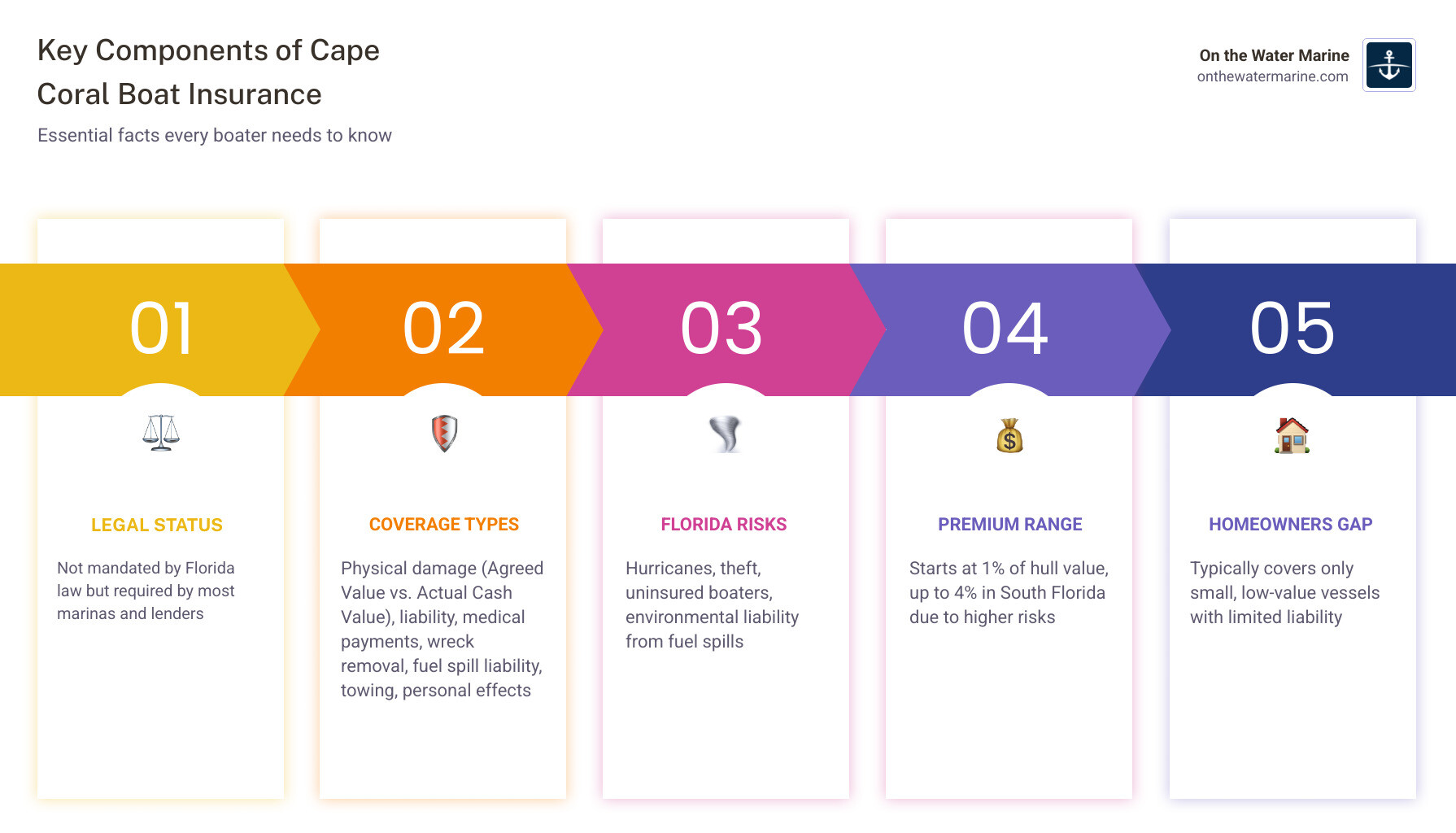
Here’s a quick overview of what Cape Coral boaters need to know:
| Topic | Key Facts |
|---|---|
| Legally required? | No — Florida does not mandate boat insurance by law |
| Marina/lender requirements | Most require proof of liability coverage |
| Homeowners coverage | Typically limited; often insufficient for larger vessels |
| Average cost | Starts at roughly 1% of hull value; South Florida can reach up to 4% |
| Key coverages | Physical damage, liability, medical payments, wreck removal, fuel spill liability |
| Florida-specific risks | Hurricanes, theft, uninsured boaters, fuel spill liability |
Florida has more registered boats than any other state. Cape Coral — with its 400+ miles of canals and direct Gulf access — sits at the center of that activity. That means more boats on the water, more risk, and more reasons to make sure your coverage actually matches your exposure.
The problem is that most boat owners don’t review their policy closely until something goes wrong. A collision, a storm, a fuel spill — these are the moments that reveal whether a policy was built for your vessel or just sold to you quickly.
“Many boat owners find out the hard way that they’re underinsured after a collision, storm, or accident.”
This guide is designed to change that. Before you renew — or buy for the first time — it’s worth understanding exactly what you’re getting.
I’m Eric Fisher, founder of On The Water Marine Insurance and a former firefighter-paramedic with nearly a decade managing national yacht insurance divisions for major carriers — experience I bring directly to helping boat owners navigate boat insurance Cape Coral and across Florida’s complex marine market. If you’re looking for clarity before making a coverage decision, you’re in the right place.
Navigating the Complexities of Boat Insurance Cape Coral

When you are cruising the Caloosahatchee River or heading out toward Sanibel, the last thing you want to worry about is whether your policy language actually protects you in a crisis. Navigating boat insurance Cape Coral requires an understanding that Florida’s marine environment is unlike any other in the country.
While the state itself may not mandate a policy, the reality of owning a 35-foot plus vessel in Southwest Florida often dictates otherwise. Whether it is the technicalities of Is Boat Insurance Required by Law? or the specific demands of a local dockmaster, the “legal” requirement is often the least of your concerns.
Understanding Local Requirements for Boat Insurance Cape Coral
In Cape Coral, the “requirement” for insurance usually comes from two places: your lender or your marina. If you finance a high-value vessel, the bank will almost certainly require a policy that protects their interest.
Furthermore, if you plan to keep your boat at a local marina, you will find that a contract is rarely signed without proof of liability coverage. Marinas are high-risk environments where one boat’s misfortune can quickly become another’s. Most facilities require specific liability limits and may even demand to be named as an “additional insured” on your Florida Boat Insurance policy to ensure they are protected if your vessel causes damage to their docks or other slips.
Homeowners Insurance vs. Specialized Marine Policies
A common misconception among new boat owners is that their existing homeowners policy will provide adequate protection. While some homeowners policies offer an endorsement for small watercraft, these are generally designed for low-value vessels or small outboards.
For a serious yacht or a professional fishing vessel, a homeowners endorsement is often riddled with coverage gaps. These “add-on” policies may lack critical Boat Insurance Coverage Florida features such as wreck removal or fuel spill liability. Furthermore, they often do not account for the specialized personal property found on larger boats, such as expensive navigational electronics or high-end fishing gear. Relying on a homeowners policy for a six-figure investment is often where the most expensive mistakes begin.
Essential Coverage Components for High-Value Vessels
When insuring a significant asset, the “fine print” becomes the most important part of the document. For vessels over 35 feet, standard “off-the-shelf” policies rarely suffice. You need a policy that understands the nuances of What Does Boat Insurance Typically Cover?, starting with how the boat is valued.
One of the most critical distinctions is between Agreed Value and Actual Cash Value. An Agreed Value policy means that in the event of a total loss, the carrier pays you the value stated on the policy, without depreciation. In contrast, an Actual Cash Value policy factors in age and wear and tear, which can leave a significant financial hole if you need to replace your vessel.
Liability and Medical Payment Options for Cape Coral Boaters
Liability is perhaps the most vital component of your boat insurance policy. It doesn’t just cover the damage you might do to another hull; it protects you against legal costs and medical expenses if someone is injured on or by your boat.
Medical payments coverage is equally essential. This coverage typically pays for injuries to you or your passengers regardless of who is at fault. This is particularly important for those who enjoy water sports or frequently host guests. Additionally, given the high number of boaters in Florida, uninsured boater protection is a wise consideration, as it may cover your expenses if you are involved in a collision with an operator who has no insurance.
It is also worth noting that for most recreational users, the IRS usually doesn’t let you deduct insurance costs, though certain exceptions apply if the vessel is used for legitimate business purposes.
Additional Endorsements for Comprehensive Protection
Beyond the basics, specialized Boat Insurance offers endorsements that can save a boat owner from massive out-of-pocket expenses.
- Towing and Assistance: This isn’t just for a dead battery; it covers on-water towing and labor, which can be incredibly expensive in the Gulf.
- Wreck Removal: If a vessel sinks, the owner is legally responsible for removing it. Without this endorsement, you could be facing a bill in the tens of thousands.
- Personal Effects: This covers items not permanently attached to the boat, such as clothing, sporting equipment, and specialized gear.
Florida-Specific Risks: Hurricanes, Fuel Spills, and Wreck Removal
In Cape Coral, the weather is more than a conversation starter—it’s a primary risk factor. Florida’s status as a hurricane-prone state significantly impacts how policies are written and priced.
Managing Fuel Spill Liability and Wreckage Removal
Florida law is very clear: if your boat leaks fuel or oil into the water, you are responsible for the cleanup. This is not a suggestion; it is a legal mandate. A standard Boat Insurance Florida Guide will emphasize that fuel spill liability is a non-negotiable coverage. Even a small spill can trigger an environmental response that costs thousands. Most marinas require this coverage as a condition of your slip agreement to ensure they aren’t left holding the bag for environmental fines.
Navigational Limits and Coastal Boundaries
Where you take your boat matters as much as the boat itself. Many policies include “navigational limits.” For example, a policy might cover you up to 75 miles from the U.S. coastline. If you plan to cruise to the Bahamas or explore the Caribbean, you may need a Boat Insurance Miami Florida Guide or a specialized endorsement to ensure your coverage remains in effect while you are in international waters. Crossing a line on a map without checking your policy could mean you are essentially uninsured the moment you enter a new territory.
Factors Influencing Marine Insurance Premiums in Southwest Florida
Understanding How Much Does Boat Insurance Cost? requires looking at several variables. Florida boat insurance is the most expensive in the country, largely due to the exposure to tropical storms. Generally, premiums start at a minimum of 1% of the hull value, but in South Florida and high-risk areas like Cape Coral, those rates can climb toward 4%.
| Feature | Standard Homeowners Endorsement | Specialized Marine Policy |
|---|---|---|
| Valuation | Often Actual Cash Value (Depreciated) | Agreed Value (No Depreciation) |
| Wreck Removal | Often Excluded or Very Limited | Included up to Policy Limits |
| Fuel Spill Liability | Rarely Included | Standard Coverage |
| Navigational Limits | Very Restricted (e.g., Inland only) | Customizable (Coastal & International) |
| Hurricane Protection | Limited or High Deductible | Specialized Storm Plans Available |
Safety Credits and Risk Mitigation
While premiums are high, there are ways to manage costs through risk mitigation. Many carriers offer credits for completing Boat Insurance Fort Myers Guide approved boater safety courses. Installing anti-theft devices and tracking systems can also help. Furthermore, demonstrating that your vessel is kept in a “safe harbor” or a hurricane-rated storage facility during storm season can positively influence your standing with underwriters.
The Role of Marine Surveys in Policy Binding
For vessels of a certain age or value, a marine survey is often a prerequisite for obtaining coverage. Carriers want a professional assessment of the vessel’s condition and fair market value before they commit to the risk. This survey protects both the insurer and the owner by ensuring the boat is seaworthy and appropriately valued. At About On the Water Marine, we often guide our clients through this process to ensure the survey meets the specific requirements of the carriers we work with.
Frequently Asked Questions about Florida Marine Insurance
Is boat insurance legally required in Florida?
No, the State of Florida does not mandate boat insurance by law. However, it is almost always required by lenders if the boat is financed and by marinas if you wish to use their facilities. Given the risks of fuel spills and liability, operating without it is a significant financial gamble.
Does my homeowners policy cover my yacht?
In most cases, no. While a homeowners policy might cover a small, low-value boat, it typically lacks the liability limits, wreck removal, and environmental protection necessary for a yacht or professional vessel.
What should I do after a boating accident in Cape Coral?
First, ensure everyone is safe and seek medical attention if needed. Florida law requires you to report any accident involving death, disappearance, or serious injury. Once safe, document the damage with photos and contact your insurance provider as soon as possible to begin the claims process.
Conclusion
Securing the right boat insurance Cape Coral is about more than finding a low premium—it’s about ensuring that when the “rogue wave” of a claim hits, your financial future stays afloat. As an independent broker, we at On the Water Marine shop multiple top-rated carriers to find the specific policy language that fits your unique vessel and navigational habits.
Our goal is to provide the expert guidance and personalized service that automated online systems simply cannot offer. We focus on the details—the hurricane plans, the navigational limits, and the agreed values—so you can focus on the water.
If you are insuring a 35’+ vessel and want to better understand your coverage options, you can Get a Quote or review our Terms of Service to see how we protect your information while finding you the best possible marine protection.
Related Articles

What Texas Boat Owners Need to Know About Boat Insurance Boat insurance Texas is not required by state law — but that doesn’t mean you can [...]
What You Need to Know Before Getting Boat Insurance Florida Quotes Boat insurance florida quotes can vary more in Florida than in almost any other state [...]
Boat Insurance Compare: A Quick-Reference Guide for Vessel Owners Boat insurance compare is the process of evaluating marine insurance policies side by side — looking beyond [...]
