

Boat Insurance Compare: A Quick-Reference Guide for Vessel Owners
Boat insurance compare is the process of evaluating marine insurance policies side by side — looking beyond the premium to understand what each policy actually covers, excludes, and pays out when something goes wrong.
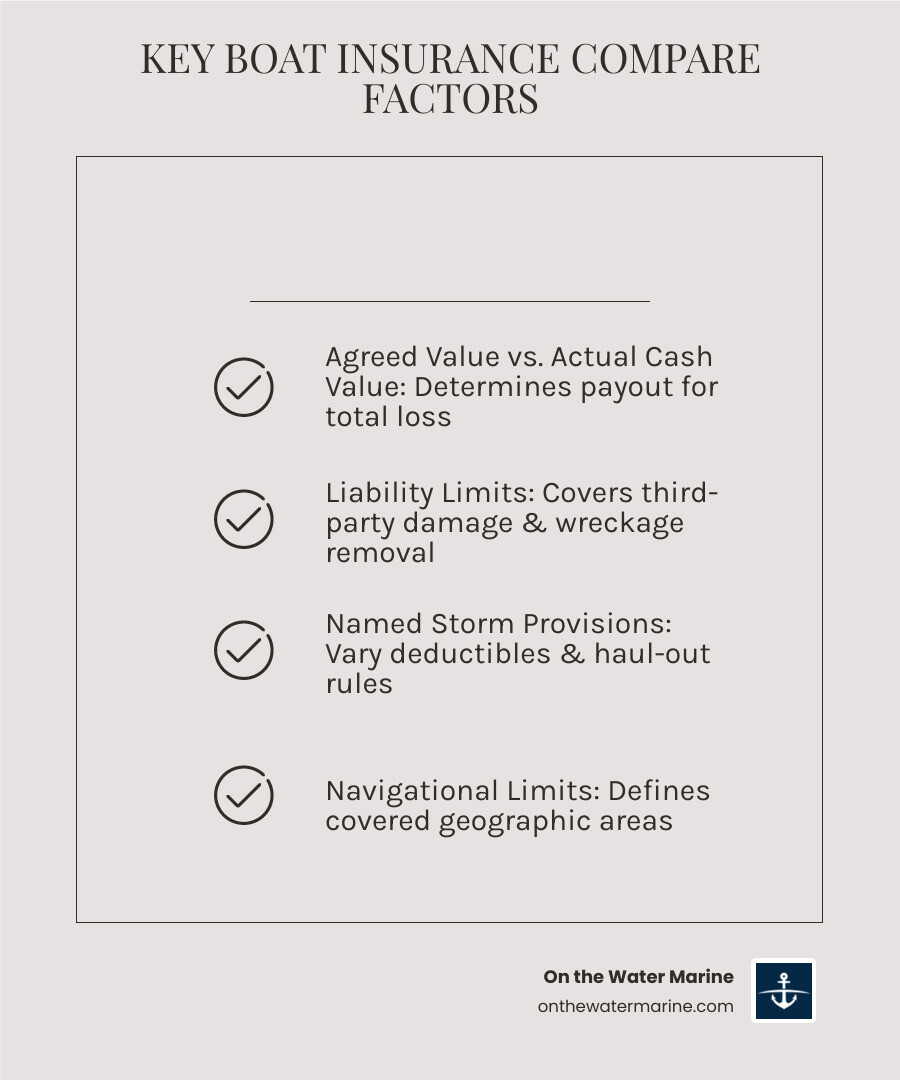
Here is a fast reference to help orient your search:
| What to Compare | Why It Matters |
|---|---|
| Agreed Value vs. Actual Cash Value | Determines your payout if the vessel is a total loss |
| Liability limits | Covers third-party damage, fuel spills, and wreckage removal |
| Named storm / hurricane provisions | Deductibles and haul-out requirements vary significantly by carrier |
| Navigational limits | Restricts where your vessel is covered geographically |
| Exclusion clauses | Defines what the policy will not respond to |
| Carrier financial strength (AM Best rating) | Matters most when a large claim is filed |
Most coverage problems don’t surface when a policy is bound. They surface when something goes wrong — and a boat owner discovers that two policies with similar premiums can respond very differently to the same loss.
That gap is exactly what this guide is designed to help you understand.
I’m Eric Fisher, founder of On The Water Marine Insurance and a former national yacht insurance division manager with over a decade of experience helping vessel owners boat insurance compare options across carriers. Before we go further, here is a quick overview of the key areas this guide will walk you through.
Understanding the Fundamentals of Boat Insurance Compare Strategies
When we begin a boat insurance compare analysis for a high-value vessel, we aren’t just looking at the bottom line. We are looking at the contract’s ability to protect your balance sheet. For a yacht valued at $250,000 or more, the distinction between a “standard” policy and a “specialized” marine policy can mean the difference between a covered loss and a catastrophic out-of-pocket expense.

One of the most critical decision points in any comparison is how the vessel is valued. In the marine insurance world, you generally choose between two primary valuation methods:
- Agreed Value: This is often the preferred choice for yacht owners. You and the carrier agree on a set value for the hull at the start of the policy. If a total loss occurs, the carrier pays that exact amount, typically without deducting depreciation.
- Actual Cash Value (ACV): This method factors in depreciation. While premiums for ACV policies may appear more attractive initially, the payout in the event of a total loss will be based on the market value of the vessel at the time of the incident, which is often significantly lower than the purchase price.
Understanding the Agreed Value vs Actual Cash Value Boat Insurance distinction is the first step in ensuring your policy aligns with your risk tolerance.
How Liability and Hull Coverage Differ in a Boat Insurance Compare Analysis
While hull coverage protects your vessel, liability coverage protects everything else. In a professional marine policy, liability (often called Protection and Indemnity or P&I) is much broader than a standard homeowners endorsement.
A robust liability section should address:
- Third-Party Property Damage: Damage you may cause to other vessels, docks, or bridges.
- Environmental Liability: Specifically, fuel spill and pollution coverage. Per the Oil Pollution Act of 1990, federal limits for fuel spill liability can exceed $1 million. Many standard policies provide much less, which is why we carefully scrutinize these limits during a boat insurance compare review.
- Wreckage Removal: If your vessel sinks in a navigable waterway, the government may legally require its removal. This can be an incredibly expensive process, often costing tens of thousands of dollars.
Evaluating the Impact of Vessel Value on Policy Selection
The value of your vessel dictates which carriers will even consider the risk. For example, some large national carriers specialize in vessels under 50 feet and values up to $500,000. Once you move into the “megayacht” or high-performance category, you may need to look toward specialized markets like Chubb or Markel, which can handle vessels worth $3 million or more.
When considering How Much Does Boat Insurance Cost, it is helpful to frame premiums as a percentage of the hull value. Generally, premiums start at a minimum of 1% of the hull value. However, geographic location plays a massive role. Florida remains the most expensive state for marine insurance, where premiums in South Florida can reach up to 4% of the vessel’s value due to the high risk of catastrophic storms.
Key Factors That Influence Marine Insurance Premiums
Insurance carriers use complex algorithms to determine risk, but for the yacht owner, several controllable factors influence the final quote.
The “who, what, and where” of your boating life matters:
- Operator Experience: Carriers look at your “resume” on similar vessels. If you are moving from a 20-foot runabout to a 45-foot twin-engine cruiser, the carrier may require professional captain training before they will bind coverage.
- Safety Certifications: Completing an approved boater safety course is one of the most consistent ways to qualify for a premium credit.
- Vessel Age and Material: Older vessels, particularly those with wood hulls or specialized construction, may face more stringent underwriting requirements or higher premiums.
Finding The Smarter Way to Shop for Boat Insurance often involves working with an independent broker who can present your “boating resume” to multiple carriers to find the one that best values your experience.
Why Navigational Limits Matter When You Boat Insurance Compare Options
In the marine world, your policy is not a “blanket” for the entire globe. Every policy includes navigational limits—a defined geographic area where your coverage is active.
Common limits include:
- Inland Waters: Specifically for lakes and rivers.
- Coastal Waters: Often defined as “East Coast US and Atlantic Coastal Waters,” sometimes with a limit on how many miles offshore you can venture (e.g., 100 or 250 miles).
- Bahamas Endorsements: Many owners in the Southeast require specific permission to cross to the Bahamas. This is often a seasonal endorsement and may come with higher deductibles.
If you stray outside these lines without notifying your carrier, you may find yourself without coverage during a claim.
The Role of Marine Surveys in Determining Coverage Eligibility
For vessels over a certain age (often 10 to 15 years) or size, a marine survey is almost always required. A professional surveyor will inspect the structural integrity, systems, and safety equipment of the boat.
Underwriters use this report to determine if the vessel meets their standards. If the survey reveals “Condition A” recommendations (safety-critical issues), the carrier will typically require proof of repair before they will issue a policy. Demystifying Boat Insurance often starts with understanding that the survey is a tool for both the carrier and the owner to ensure the vessel is seaworthy.
Specialized Coverage Options for High-Value Vessels
Standard policies often leave gaps that only a specialized marine policy can fill. When we boat insurance compare for our clients, we look for these “yacht-specific” additions.
- Mechanical Breakdown: Some policies offer endorsements for mechanical failure of the engine or lower unit, which is typically excluded under “wear and tear” in basic policies.
- Personal Effects: High-value vessels often carry expensive electronics, scuba gear, and personal items. We look for policies that offer significant limits (sometimes up to $10,000 or more) for these items.
- Fishing Equipment: For sport fishing enthusiasts, specialized endorsements for rods, reels, and even tournament fee reimbursement can be vital. Our Cruisers and Motor Yacht Insurance options often include these nuances.
How Hurricane and Named Storm Provisions Affect a Boat Insurance Compare Review
If you boat in Florida or along the Gulf Coast, the “Hurricane Box” is a reality of life. Carriers often have very specific requirements for vessels located in these areas during hurricane season (typically June 1 through November 30).
Key areas to compare include:
- Haul-Out Coverage: Some carriers will reimburse you (up to a certain limit, like $1,000) to have your boat professionally hauled out and stored on land when a named storm is approaching.
- Storm Plans: You may be required to submit a written plan detailing where the boat will go and how it will be secured if a hurricane warning is issued.
- Deductibles: It is common for policies to have a separate, higher deductible for “Named Storm” damage. This is often a percentage of the hull value (e.g., 5% or 10%) rather than a flat dollar amount.
For a deeper dive, our Boat Insurance Florida Guide explains how these geographic factors can shift your coverage landscape.
Addressing Unique Risks for Tenders and Personal Watercraft
Many large yachts carry a dinghy or a tender. While some policies automatically include a small tender, larger or more expensive tenders may need to be specifically scheduled on the policy.
It is also important to note that while some liability may extend to the use of water sports equipment, separate personal watercraft policies are often necessary for jet skis or high-speed tenders to ensure full protection. Owners of sailing vessels should also review their Sailboat Insurance to ensure their auxiliary engines and tenders are properly accounted for.
How to Effectively Boat Insurance Compare Quotes from Multiple Carriers
The most important part of a boat insurance compare exercise is knowing who is standing behind the policy.
We always check the AM Best Rating of a carrier. This rating measures the financial stability of the insurance company. For a $500,000 claim, you want a carrier with an “A” (Excellent) rating or better.
Another critical distinction is whether the carrier is Admitted or Surplus Lines:
- Admitted Carriers: These are backed by the state’s guarantee fund and their rates/forms are approved by the state insurance department.
- Surplus Lines: These carriers handle higher-risk or more complex vessels that admitted carriers won’t touch. While they don’t have the same state backing, they offer the flexibility needed for unique marine risks.
You can read more about this in our guide on Admitted vs Surplus Lines Boat Insurance.
Comparing Policy Language Beyond the Premium
A lower premium often indicates that the carrier has restricted coverage in the fine print. When we perform a boat insurance compare for a client, we look for:
- Lay-up Periods: Does the policy require the boat to be out of the water during winter months? If you decide to take a late-season cruise and have a claim, it could be denied if you are in a lay-up period.
- Charter Usage: Most pleasure craft policies strictly prohibit any “for hire” use. If you occasionally charter your vessel, you need a specific commercial endorsement.
- Exclusion Clauses: Every policy excludes “wear and tear,” but some also exclude “consequential damage” (e.g., if a worn hose bursts and sinks the boat, some policies won’t pay for the sinking because it started with wear and tear).
If you feel your current policy is too good to be true, you might ask: Are You Overpaying for Boat Insurance, or are you simply under-insured?
The Importance of Specialized Claims Handling
When a yacht is damaged, you don’t want an auto adjuster looking at it. You want a marine specialist. Specialized carriers employ adjusters who understand fiberglass repair, marine propulsion, and salvage laws.
The right policy should allow you to choose a reputable repair yard and should include “Salvage Rights,” which can be a complex legal area if your boat is grounded or sinking. This is the core of Boat Insurance 101: the policy is only as good as the claims experience it provides.
Frequently Asked Questions about Marine Coverage
Is boat insurance legally required for large vessels?
In most states, boat insurance is not legally mandated by the government (exceptions include Arkansas and Utah for certain vessels). However, it is almost always required by:
- Lenders: If you have a boat loan, the bank will require hull coverage.
- Marinas: Most professional marinas require proof of liability insurance (often $300,000 to $500,000) before they will give you a slip.
We provide coverage across many regions; you can check our States Serviced for more details.
How does yacht insurance differ from a standard homeowners policy?
A homeowners policy may offer a small endorsement for a boat, but it usually caps the value at a low amount (e.g., $1,000 – $5,000) and provides very limited liability. A true marine policy covers specialized perils like sinking, salvage, and fuel spills that a home policy is not designed to handle. Generally, we advise against it: Should I Bundle My Boat Insurance with My Home Insurance? Usually, the answer is no for vessels over 30 feet.
Does a policy typically cover boat trailers or specialized equipment?
Trailers can often be added as a “scheduled” item on the policy. Similarly, if you have $20,000 in custom fishing gear or high-end electronics, these should be specifically mentioned to ensure they are covered at their full value rather than being subject to a small “personal effects” limit.
Conclusion
Navigating marine insurance requires more than just a search for the lowest rate. It requires a strategic boat insurance compare approach that prioritizes the unique needs of your vessel and your cruising lifestyle.
At On The Water Marine, we function as an independent brokerage. We don’t work for the insurance companies; we work for you. We shop multiple top-rated carriers to find the specific policy language that protects your investment, whether you are navigating the Great Lakes or cruising the Florida Keys.
If you are insuring a 35’+ vessel and want to better understand your coverage options, you can request a personalized marine insurance consultation with our team today.
Related Articles

Florida Has Some of the Highest Boat Insurance Rates in the Country — Here’s What to Expect Boat insurance Florida rates are among the most expensive [...]
Why Personal Watercraft Policies Matter for Marine Asset Protection A personal watercraft policy is a specialized marine insurance contract designed to protect operators and owners of [...]
What Is Commercial Marine Insurance — and Why It Matters for Your Business Commercial marine insurance is a category of specialized coverage designed to protect businesses [...]

