

Why “Boat Insurance Florida Cost” Is Often a Misleading Starting Point
Most marine insurance problems don’t appear when a policy is bound — they appear when something goes wrong and the owner finds out what key terms actually mean.
If you own (or are purchasing) a 35’+ yacht in Florida, “cost” is usually the downstream result of underwriting decisions about hurricane exposure, storage, navigation limits, operator experience, and—most importantly—policy language.
This article is written to help you avoid expensive misunderstandings. It focuses on why premiums vary and where the real tradeoffs tend to be, so you can evaluate quotes on clarity and suitability—not just the number.
What typically drives premium differences in Florida
| Factor | Why it matters |
|---|---|
| Vessel value and repair complexity | Higher-value yachts generally involve higher potential claim severity and more specialized repair work |
| Hurricane and named storm exposure | Florida’s catastrophe risk often changes deductibles, navigation requirements, and carrier appetite |
| Deductible structure (including named storm) | Lower premiums often involve tradeoffs in out-of-pocket responsibility during a storm loss |
| Storage and haul-out plan | Indoor/dry storage and documented storm plans may influence eligibility and terms |
| Valuation method | Agreed value and actual cash value can lead to very different outcomes after a total loss |
Florida’s year-round boating season, dense marinas, theft exposure, and hurricane risk create an underwriting environment that’s materially different than many other states.
I’m Eric Fisher, founder of On The Water Marine Insurance. I’ve spent over a decade working in marine insurance and marine risk, including managing national yacht insurance divisions and responding to marine incidents as a firefighter-paramedic on river rescue boats.
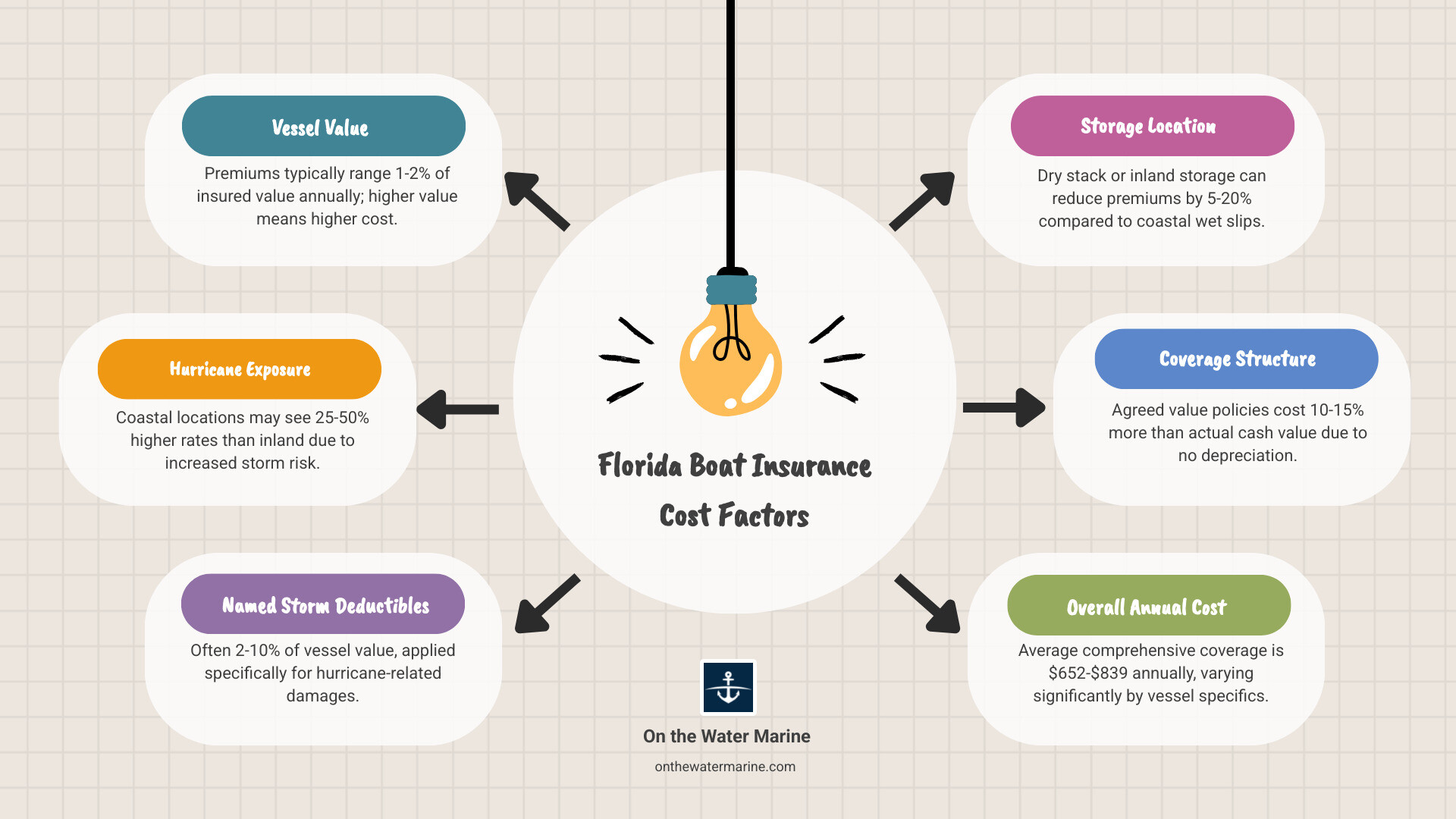
Primary Factors That Influence Boat Insurance Premiums in Florida
When underwriters price a Florida yacht risk, they’re generally pricing the likelihood of a loss and the potential severity of that loss. Even though Florida doesn’t legally require insurance for most recreational boats, lenders and marinas often require specific limits or coverage types.
For 35’+ yachts, vessel value is a major driver—but it’s rarely the only one. Construction type, maintenance history, and the availability of qualified repair facilities can all influence how a carrier views the risk.

Length overall (LOA) matters because larger yachts typically have more complex systems and higher repair exposure. Horsepower and performance profile can also affect underwriting, since higher speeds may increase the probability and severity of a navigational loss.
Operator experience is another area that’s often misunderstood. Carriers commonly look for demonstrated experience with similar size and type of vessel, prior ownership history, and any formal training. Depending on the carrier, documented training (e.g., Coast Guard Auxiliary or U.S. Power Squadrons courses) may help eligibility or terms.
If you’re comparing quotes that don’t ask about experience, storage, or storm planning, it’s worth slowing down. In many cases, the “simpler” quote process is also where important assumptions get made—sometimes in ways you won’t notice until a claim or renewal.
Understanding Regional Risk and Hurricane Exposure
Florida’s geography is its greatest asset and its most significant insurance challenge. The National Oceanic and Atmospheric Administration (NOAA) notes that Florida has a nearly 40% chance of being affected by a named storm in any given year. This coastal vulnerability is the primary reason Florida premiums are often 25% to 50% higher than the national average.
The concentration of high-value vessels in hurricane-prone corridors like Miami, Fort Lauderdale, and the Gulf Coast creates a “catastrophe risk” for carriers. To manage this, many policies include specific geographic “navigation limits” that may require the vessel to be moved north of a certain latitude or inland during the peak of hurricane season. Developing a robust Hurricane Preparedness Plan is not just a safety measure; it is often a requirement for maintaining coverage in high-risk zones.
The Role of Storage Location in Boat Insurance Florida Cost
Where you keep your boat when you aren’t using it has a direct impact on your premium. Vessels kept in a “hurricane-rated” dry stack facility or an inland private dock generally attract lower rates than those kept on a mooring or in an exposed coastal marina.
Storage location impact can be summarized as follows:
- Inland Storage: Typically the lowest risk, potentially reducing premiums by 10-20%.
- Dry Stack Facilities: Offers protection from surge and hull-related claims, often resulting in lower rates.
- Coastal Marinas: Higher exposure to wind and surge, leading to standard or liftd premiums.
For those navigating these choices, our page on Florida Boat Insurance details how storage decisions influence policy options.
Navigating Named Storm Deductibles and Policy Credits
In Florida, the standard deductible (often 1% of the hull value) usually applies to most claims, such as a fire or a collision. However, “Named Storm” or “Hurricane” deductibles are common in this market. These are often percentage-based, ranging from 2% to 10% of the vessel’s insured value.
For example, on a yacht valued at $500,000, a 5% hurricane deductible means the owner is responsible for the first $25,000 of damage resulting from a named storm. While a higher deductible can lower the annual premium, it increases the owner’s out-of-pocket risk. Some carriers offer policy credits for “storm haul-out” coverage, which may reimburse a portion of the costs to move the vessel to safety when a storm warning is issued. This is a critical component of Boat Insurance 101: Don’t Let Hurricane Season Sink Your Boat.
Comparing Agreed Value and Actual Cash Value Structures
One of the most significant choices affecting boat insurance florida cost is how the vessel is valued in the event of a total loss.
- Agreed Value: The insurer and owner agree on a fixed value for the vessel at the start of the policy. If a total loss occurs, the policy pays that exact amount without depreciation. This is typically 10-15% more expensive but provides essential financial certainty for newer or high-value yachts.
- Actual Cash Value (ACV): This structure pays the market value of the boat at the time of the loss, accounting for depreciation. While premiums are lower, the payout may not be sufficient to replace the vessel or pay off a loan.
Understanding the nuances of Agreed Value vs. Actual Cash Value Boat Insurance is vital for any serious owner.
| Feature | Agreed Value | Actual Cash Value |
|---|---|---|
| Premium Cost | Higher | Lower |
| Total Loss Payout | Fixed amount (no depreciation) | Market value (depreciated) |
| Partial Loss Repairs | Usually “new for old” | Often depreciated based on age |
| Best For | New/High-value yachts | Older/Lower-value vessels |
Liability-Only vs. Comprehensive Coverage Considerations
For owners of older vessels or those who are self-insuring the hull risk, liability-only policies are an option. These policies start at a much lower price point—often between $100 and $300 annually—and cover third-party property damage and bodily injury.
However, for most owners of 35-foot-plus vessels, comprehensive coverage is the standard. This protects the physical hull against fire, theft, vandalism, and storm damage. When we look at What Does Liability Boat Insurance Cover?, it becomes clear that while liability is the foundation, it does nothing to protect the owner’s significant capital investment in the yacht itself.
Professional Guidance for High-Value Marine Risks
Navigating the Florida insurance market is rarely a straightforward process of comparing price tags. Policy language varies significantly between carriers, particularly regarding “consequential damage,” “mechanical breakdown” exclusions, and “fuel spill liability.”
For owners of sophisticated vessels, working with a specialist who understands Yacht Insurance and Cruisers and Motor Yacht Insurance is the best way to ensure the policy matches the risk. A professional risk assessment can identify gaps—such as inadequate limits for personal effects or uninsured boater coverage—that a generic online quote might miss.
Frequently Asked Questions about Florida Boat Insurance
Is boat insurance legally required in Florida?
While Florida state law does not require boat insurance for most recreational vessels, it is almost always required by lenders if the boat is financed and by marinas for mooring or slip agreements. Additionally, certain high-risk vessels or commercial operations may face specific state mandates.
How does a credit score impact marine insurance rates?
In Florida, many carriers use “insurance scores,” which include credit history, to help determine premiums. Underwriters have found a statistical correlation between financial responsibility and safety on the water. A higher credit score may lead to lower premiums or access to preferred carrier tiers.
What is a named-storm deductible and how does it function?
A named-storm deductible is a separate, usually higher deductible that applies only to damage caused by a storm officially named by the National Hurricane Center. In Florida, these are often calculated as a percentage of the vessel’s insured value (e.g., 2%, 5%, or 10%) rather than a flat dollar amount.
Conclusion
Managing your boat insurance florida cost is a balance of understanding risk and choosing the right coverage structure. At On The Water Marine, we serve as independent brokers, shopping multiple top-rated carriers to find the coverage that aligns with your specific vessel and cruising plans. Our focus is on providing the personalized service and expert guidance necessary to steer Florida’s complex waters.
If you are insuring a 35’+ vessel and want to better understand how these factors apply to your specific situation, a professional review of your Florida Boat Insurance options may be worthwhile.
Related Articles

Why Charter Captain Insurance Requires a Different Lens Most insurance problems do not show up when a policy is bound. They show up when something goes [...]
Why Some Vessels Are Considered Hard to Insure When a vessel is hard to insure, it typically means underwriters see liftd risk due to factors like [...]
Navigating Marine Insurance: Clarity for Port St. Lucie Yacht Owners Most marine insurance problems do not appear when a policy is issued. They tend to surface [...]

