

What You Need to Know Before Getting Boat Insurance Florida Quotes
Boat insurance florida quotes can vary more in Florida than in almost any other state — and the gap between a policy that looks good on paper and one that may actually protect you when something goes wrong can be significant.
Here’s a quick overview of what to expect:
| Factor | What to Know |
|---|---|
| Legal requirement | Florida does not require boat insurance by state law, but lenders and marinas often do |
| Premium trends | Premiums may typically start at approximately 1% of hull value |
| South Florida | Costs may reach up to 4% of hull value due to hurricane exposure and theft risk |
| How to get quotes | Online quote tools, phone, or through an independent marine insurance broker |
| What affects your quote | Boat type, hull value, storage location, engine horsepower, navigation area, and claims history |
| Key coverages to look for | Liability, hull and equipment, towing, wreckage removal, and named storm coverage |
Most insurance problems don’t show up when a policy is bound. They show up when something goes wrong — and the policy language doesn’t say what you thought it said. That’s especially true in Florida, where year-round boating, hurricane season, and some of the highest vessel density in the country create a risk environment unlike anywhere else in the U.S.
I’m Eric Fisher, founder of On The Water Marine Insurance and a marine insurance specialist with over a decade of experience helping boat and yacht owners navigate boat insurance florida quotes — including nearly ten years managing national yacht insurance divisions for major carriers. In this guide, I’ll walk you through what often shapes a quote, what coverage components are typically necessary, and how to avoid common mistakes Florida boaters make.
Navigating Florida’s Marine Insurance Requirements

A common point of confusion for those new to the Sunshine State is whether coverage is actually a legal mandate. Strictly speaking, Florida state law does not require you to carry insurance for a private vessel. However, viewing insurance as “optional” is often a mistake that overlooks the realities of modern boat ownership.
While the state doesn’t mandate it, other entities certainly do. If you have a marine loan or any form of financing on your vessel, your lender will almost certainly require you to maintain physical damage coverage to protect their investment. Furthermore, if you plan to keep your boat at a professional marina in cities like Miami, Fort Lauderdale, or Jacksonville, you will likely be asked for proof of liability insurance. Marinas require this to ensure that if your vessel causes damage to their docks or other high-value yachts, there is a way to settle the claim.
Beyond these requirements, the question of Is Boat Insurance Required often comes down to personal risk management. Florida has one of the highest concentrations of boaters in the country. With high vessel density comes an increased risk of third-party liability. Even if your boat is paid off and stored on a private lift, a single collision or a fuel spill can result in catastrophic financial exposure. For more detailed insights, you can explore our Florida Boat Insurance guide.
Understanding the Variables in Boat Insurance Florida Quotes
When you begin searching for boat insurance florida quotes, you will quickly notice that rates are not uniform across the state. Florida is considered a “high-risk” state by many carriers, and several specific variables will influence the premium you are offered. This is true whether you are looking at standard carriers or specialized options like Marine Guide insurance.
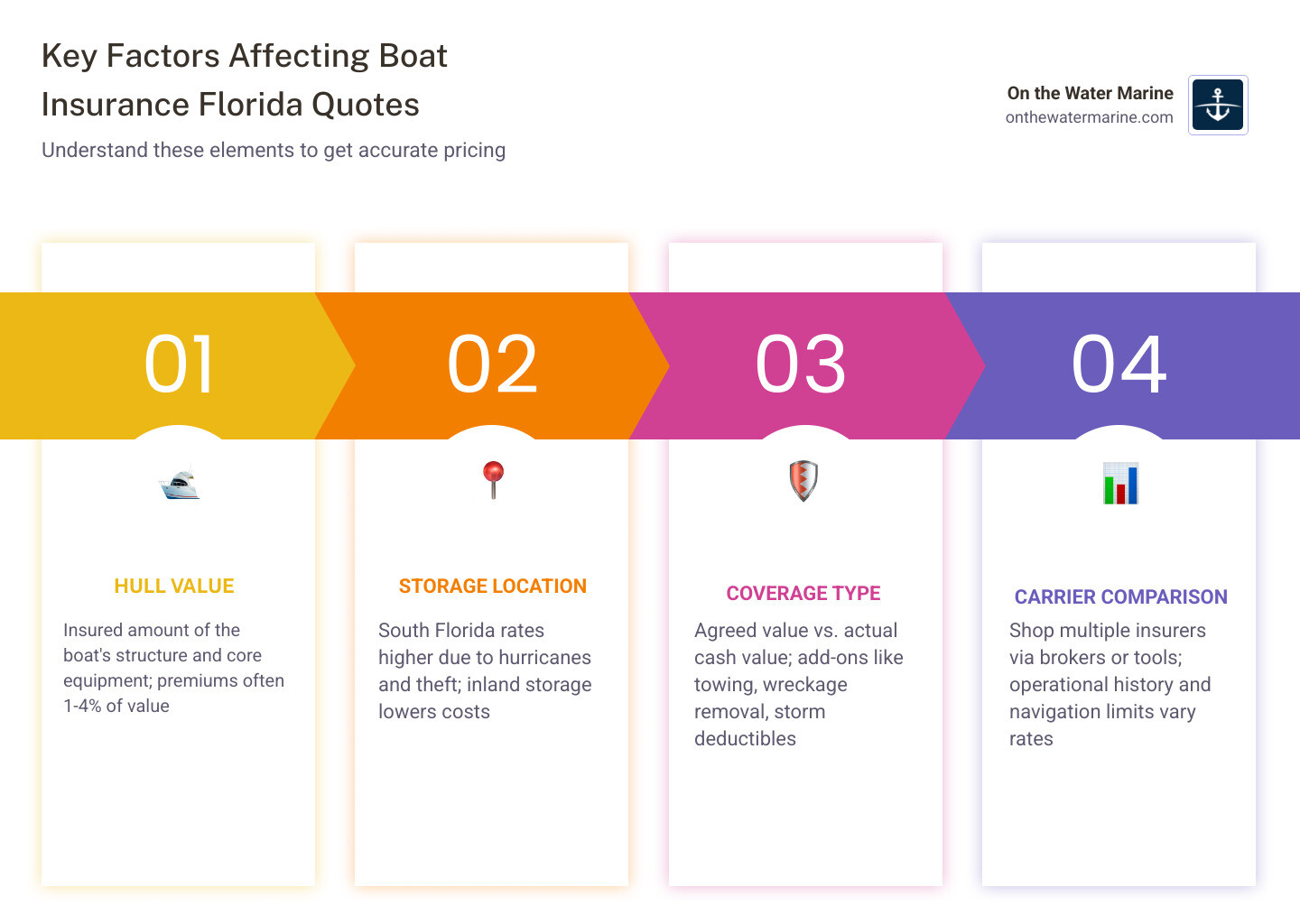
Geography plays a massive role. In South Florida, where the concentration of luxury yachts is high and the exposure to tropical storms is greatest, premiums may be significantly higher than in the Panhandle or inland regions. In fact, South Florida rates may reach up to 4% of the hull value, whereas other areas might start closer to 1%.
Navigation limits are another critical factor. A policy that limits you to Florida’s coastal waters will likely have a different cost structure than one that includes the Bahamas or the Caribbean. Carriers also look closely at your vessel’s storage location. A boat kept in a hurricane-rated dry stack facility may receive more favorable terms than one kept on a trailer in a driveway.
To better understand these nuances, our Boat Insurance Florida Cost Guide provides a deeper breakdown. It can also be helpful to monitor broader market updates from major insurers and industry sources, such as the Progressive Newsroom.
How Vessel Specifications Impact Boat Insurance Florida Quotes
The physical characteristics of your boat are just as important as where you keep it. Carriers evaluate:
- Engine Horsepower and Speed: High-performance vessels capable of extreme speeds often face stricter underwriting and higher premiums.
- Hull Material and Age: While some carriers are hesitant to insure older vessels or those with wood hulls, others specialize in these niche markets.
- Vessel Type: A 45-foot cruising yacht has a different risk profile than a professional sportfishing vessel.
For a comprehensive look at how these specs change your options, refer to our Boat Insurance Florida Guide.
Strategic Considerations for Boat Insurance Florida Quotes
There are ways to refine your quote through strategic decisions. For instance, choosing a higher deductible can lower your annual premium, though this means you take on more initial risk in the event of a claim.
Your personal history is also a factor. A claims-free history and a solid Credit Rating can often lead to better rates. Many carriers also offer credits for completing state-approved boater safety courses or for having years of experience operating similar vessels.
Essential Coverage Components for High-Value Vessels
When evaluating boat insurance florida quotes, it is vital to look beyond the premium and examine the specific coverage components. For high-value vessels, the distinction between “Agreed Value” and “Actual Cash Value” is paramount. An Agreed Value policy is designed so that in the event of a total loss, the carrier may pay the amount listed on the policy without accounting for depreciation.
Other essential coverages that are often overlooked include:
- Fuel Spill Liability: Florida’s environmental laws are strict; a leaking tank can lead to massive fines and cleanup costs.
- Wreckage Removal: If a vessel sinks in a navigable waterway, the owner is often legally required to remove it, which can be an incredibly expensive process.
- Mechanical Breakdown: Specialized endorsements for mechanical breakdown may cover mechanical failures of lower units or engines due to wear and tear.
Understanding What Boat Insurance Actually Covers is one way to help ensure you aren’t left with a “naked” risk. You can also research how major carriers are positioning their marine products in the current market. For more specific details on what we can offer, check out Boat Insurance Coverage Florida.
Managing Environmental Risks and Hurricane Preparedness
In Florida, the “elephant in the room” is always hurricane season. This single factor dictates much of the marine insurance landscape in the state. Most boat insurance florida quotes will include a specific “Named Storm Deductible,” which is often higher than your standard hull deductible.
Carriers often require a formal Hurricane Preparedness Plan for vessels of a certain size or value. This plan outlines exactly where the boat will go and how it will be secured when a storm approaches. Some policies even offer “Haul-Out Coverage,” which reimburses a portion of the cost to have your boat professionally pulled from the water and stored safely during a tropical storm or hurricane warning.
Ignoring these risks can lead to a denied claim or a non-renewal of your policy. We recommend staying updated on the 2024 Hurricane Season and reviewing our guide on Boat Insurance 101: Don’t Let Hurricane Season Sink Your Boat to ensure your coverage remains intact when the clouds gather.
Frequently Asked Questions
Does Florida homeowners insurance cover my vessel?
In many cases, a homeowners policy may provide very limited coverage for small, non-motorized craft stored on your property. However, for vessels over 35 feet or those with significant engines, the coverage is usually non-existent or capped at a minimal amount. Most importantly, homeowners policies rarely provide the specialized marine liability coverage needed for on-water incidents. Relying on your home policy could mean you are overpaying for boat insurance by not having the right protection when you need it.
Are marine surveys required for all Florida policies?
This often depends on the age and value of the vessel. For older boats—typically those 10 to 20 years or older—carriers will likely require a professional marine survey before binding a policy. This helps the underwriter understand the current condition of the hull and machinery. Demystifying Boat Insurance surveys can help you prepare for this step in the quoting process.
What are the most common claims in Florida waters?
The most frequent claims we see involve striking submerged objects (like sandbars or debris), theft of electronics or the vessel itself, and damage resulting from hurricanes. Because Florida has so much coastal traffic, collisions are also a significant risk. If you are interested in the industry side of things, you can research how claims are handled by reviewing carrier-specific documentation or industry reports.
Conclusion
Finding the right boat insurance florida quotes doesn’t have to be an overwhelming process, but it does require attention to detail. At On The Water Marine, we operate as an independent brokerage, which means we aren’t tied to a single carrier. We shop multiple top-rated providers to help identify policy language that may fit your vessel and your lifestyle.
If you are insuring a 35’+ vessel and want to better understand your coverage options in the complex Florida market, we are here to provide expert guidance. You can Get a Quote today to see how our personalized approach can help clarify your options and help protect your investment for years to come. For more information, visit our Florida Boat Insurance page.
Related Articles

What Texas Boat Owners Need to Know About Boat Insurance Boat insurance Texas is not required by state law — but that doesn’t mean you can [...]
Boat Insurance Compare: A Quick-Reference Guide for Vessel Owners Boat insurance compare is the process of evaluating marine insurance policies side by side — looking beyond [...]
Florida Has Some of the Highest Boat Insurance Rates in the Country — Here’s What to Expect Boat insurance Florida rates are among the most expensive [...]