

Florida Has Some of the Highest Boat Insurance Rates in the Country — Here’s What to Expect
Boat insurance Florida rates are among the most expensive in the United States, and for good reason. Before you compare options or choose a policy, it is important to understand that typical annual costs for policies offering comprehensive-style protection may range from 1% to 4% of the vessel’s insured value, depending on the location and risk profile.
A few key facts to know upfront:
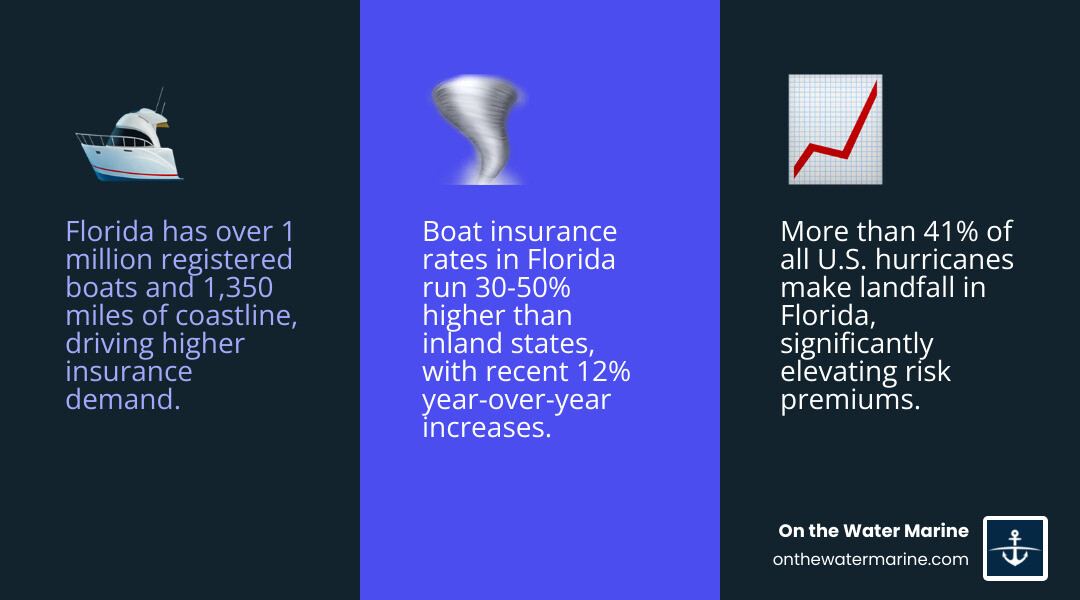
- Florida has over 1 million registered boats and 1,350 miles of coastline
- More than 41% of all U.S. hurricanes make landfall in Florida
- Florida rates often run 30-50% higher than comparable inland states
- Rates have trended upward roughly 12% year-over-year in recent years
- Most policies carry a separate hurricane deductible — often 2-10% of insured value
The numbers alone don’t tell the full story, though. What you pay depends heavily on your vessel, where you keep it, how you use it, and what coverage structure you choose. A bass boat kept on a freshwater lake in Central Florida is a very different risk profile than a 40-foot cruiser docked in a South Florida marina during hurricane season.
This is where many boat owners run into trouble — they shop on price alone, without fully understanding what their policy does and doesn’t cover until something goes wrong.
I’m Eric Fisher, founder of On The Water Marine Insurance and a licensed marine insurance specialist with over a decade of experience managing yacht insurance for national carriers — experience that directly shapes how I approach boat insurance Florida rates and coverage for high-value vessels. In the sections below, I’ll walk you through the key variables that drive your premium and what to look for in a policy designed to protect your investment.
Understanding the Variables of Boat Insurance Florida Rates
When we discuss the cost of protecting a vessel in the Sunshine State, it is important to recognize that premiums are not arbitrary. For many policies offering comprehensive-style protection, 1% to 2% of the boat’s insured value may serve as a baseline for annual premiums. However, for vessels located in South Florida or those with high-performance specifications, that figure can frequently reach 4%.
The Boat Insurance Florida Cost Guide highlights that insurers view every vessel as a unique combination of risks. Unlike standard auto insurance, marine underwriting looks closely at the relationship between the hull’s value and its exposure to environmental hazards. If you are navigating a 45-foot sportfishing yacht, your risk profile is fundamentally different from a smaller freshwater vessel.
Why Geography Influences Boat Insurance Florida Rates
Geography is perhaps the most significant driver of cost in our state. Florida’s coastline density and its geographical position make it a high-traffic area with significant weather exposure. According to the National Oceanic and Atmospheric Administration, Florida has a 40% probability of being affected by a named storm in any given year.
This regional exposure is why a boater moving a vessel from the Great Lakes to Fort Lauderdale may see their premium increase significantly. The year-round boating season in Florida also means more hours on the water, which statistically increases the likelihood of a claim compared to northern states where boats are winterized for half the year.
How Vessel Specifications Impact Boat Insurance Florida Rates
Beyond where you boat, the physical characteristics of the vessel play a vital role. The coverage structure you select should consider:
- Horsepower: High-performance engines and high speeds generally correlate with higher liability and hull premiums.
- Hull Material: Specialized materials like carbon fiber or high-end composites may involve higher repair costs, influencing the rate.
- Vessel Age: Older vessels (typically 20-25+ years) often require a marine survey to secure coverage, and some carriers may limit the types of policies available for older hulls.
The Impact of Hurricane Exposure on Premium Structures
In Florida, the “hurricane surcharge” is a reality of the market. Because over 41% of U.S. hurricanes make landfall here, insurers must structure policies to survive catastrophic loss years. This has led to a market where Florida rates have trended upward, often increasing by 12% or more annually following active storm seasons.
Scientific research on climate trends suggests that while the frequency of storms may vary, the intensity of landfalling hurricanes is a primary concern for marine underwriters. To manage this, many policies include a “storm haul-out” provision, which may reimburse a portion of the costs to move your vessel to a safer location when a named storm warning is issued. Our Boat Insurance Florida Guide provides further detail on how these provisions can help protect both the vessel and the owner’s financial interests.
Navigating Hurricane Deductibles and Boat Insurance Florida Rates
One of the most misunderstood aspects of Florida marine insurance is the hurricane deductible. While a standard deductible for fire or theft might be a flat dollar amount, a hurricane deductible is often expressed as a percentage of the hull value—typically between 2% and 10%.
For a high-value yacht, a 5% hurricane deductible means the owner is responsible for a significant portion of damage resulting from a named storm before the policy responds. Understanding this distinction is critical for risk mitigation. In many cases, storing a vessel in a hurricane-rated dry stack or an inland facility can lead to more favorable terms compared to keeping it in a coastal marina. You can find more on these regional nuances in our guide to Florida Boat Insurance.
Essential Coverage Considerations for High-Value Vessels
For owners of vessels over 35 feet, generic “one-size-fits-all” policies are often insufficient. The coverage may be required by your lender or marina, but the quality of that coverage is what matters during a loss.
When evaluating Boat Insurance Coverage Florida, there are two primary methods for valuing the hull:
- Agreed Value: The insurer and owner agree on the vessel’s value at the start of the policy. In the event of a total loss, this is typically the amount paid, without depreciation.
- Actual Cash Value (ACV): This is designed to pay out the market value of the vessel at the time of the loss, accounting for depreciation. For serious yacht owners, Agreed Value is often the preferred choice to assist in replacing the vessel with one of similar quality.
Liability vs. Comprehensive-Style Protection
While liability-only coverage may satisfy a marina’s basic requirements, it leaves the owner’s investment potentially exposed. A policy providing comprehensive-style protection in Florida may include:
- Wreck Removal: Highly important if a vessel sinks, as the cost of raising and removing a hull can exceed the value of the boat itself.
- Environmental Spill Coverage: Federal and state fines for fuel spills can be astronomical; verifying that your policy covers these “sudden and accidental” events is highly recommended.
- Uninsured Boater: Given that Florida does not mandate insurance, this is designed to protect you if you are hit by an operator who lacks coverage.
Our Florida Boat Insurance Guide explains how these layers of protection work together to shield your assets.
Factors That May Influence Your Annual Premium
Several personal factors can help refine your boat insurance florida rates. While the market is generally high, individual qualifications can lead to more competitive offers. High-value yacht owners often benefit from the manual underwriting process where specific safety measures are highlighted.
For a deeper look at the math behind these premiums, you can review our resource on How Much Does Boat Insurance Cost?.
Professional Qualifications and Discounts
Carriers often reward “preferred” risks. You may see rate adjustments based on:
- Operator Experience: A clean boating and driving record can lead to significant credits. Interestingly, many insurers find a correlation between responsible automobile driving and safe vessel operation.
- Safety Certifications: Completing a state-approved boating safety course can often trim 5% to 15% off a premium.
- Navigation Limits: Restricting your navigation to specific areas (e.g., staying within Florida coastal waters rather than cruising to the Caribbean) can lower the perceived risk.
It is also worth noting that while Florida does not mandate boat insurance for most private vessels, the lack of a legal requirement does not eliminate the financial liability of an accident or environmental mishap.
Frequently Asked Questions about Florida Boat Insurance
Is boat insurance legally required for Florida residents?
Florida law does not currently mandate boat insurance for most recreational vessels. However, if you have a lien on the boat, your lender will likely require a policy that includes physical damage coverage. Additionally, almost all reputable Florida marinas require proof of liability insurance before allowing you to dock.
How do hurricane deductibles differ from standard deductibles?
A standard deductible typically applies to common claims like theft or minor collisions. A hurricane (or “named storm”) deductible is typically triggered when damage is caused by a storm officially named by the National Hurricane Center. These are almost always higher than standard deductibles and may be calculated as a percentage of the boat’s insured value.
Does a standard Florida policy provide coverage for the Bahamas?
Many Florida policies include a “navigation limit” that extends 75 to 100 miles offshore, which may include the Bahamas. However, this is not guaranteed. Some policies exclude these waters during peak hurricane season or require a specific endorsement. Always verify your navigation limits with your advisor before crossing the Gulf Stream.
Conclusion
Navigating the complexities of boat insurance florida rates requires more than just a search for the lowest number. Because Florida is a unique marine environment with significant hurricane exposure and high vessel density, the lowest-premium policy may carry hidden costs in the form of high deductibles or restrictive coverage language.
At On the Water Marine, we operate as an independent brokerage. This means we don’t work for one single insurance company; we work for you. We have access to specialized carriers that do not offer policies directly to the public, intended to help us find a balance of protection and premium. Whether you are insuring a high-end center console or a 60-foot motoryacht, we provide the risk-aware consultation intended to help protect your time on the water.
Related Articles

Why Personal Watercraft Policies Matter for Marine Asset Protection A personal watercraft policy is a specialized marine insurance contract designed to protect operators and owners of [...]
What Is Commercial Marine Insurance — and Why It Matters for Your Business Commercial marine insurance is a category of specialized coverage designed to protect businesses [...]
What Florida PWC Owners Often Miss Until a Claim Happens Most insurance problems don’t show up when a policy is purchased — they show up after [...]


