

What Is Commercial Marine Insurance — and Why It Matters for Your Business
Commercial marine insurance is a category of specialized coverage designed to protect businesses that operate vessels, ship cargo, or provide maritime services from the financial consequences of loss, damage, and liability at sea.
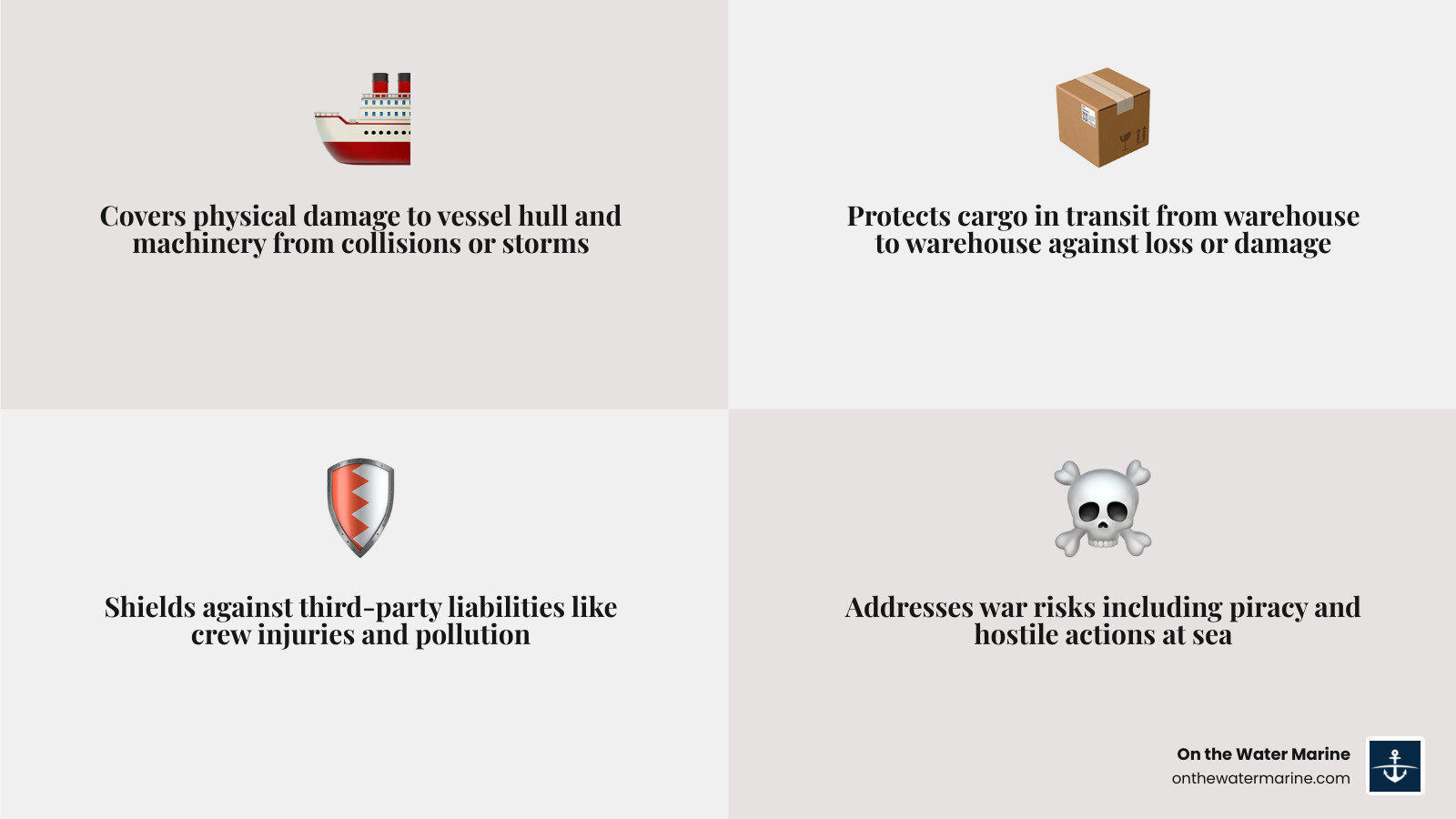
Here is a quick overview of what it typically includes:
| Coverage Type | What It Protects |
|---|---|
| Hull & Machinery (H&M) | Physical damage to the vessel and its equipment |
| Cargo Insurance | Goods in transit, warehouse-to-warehouse |
| Protection & Indemnity (P&I) | Third-party liability, crew injuries, pollution |
| Marine Liability | Ship repairers, marina operators, stevedores |
| War Risks | Piracy, insurrection, weapons-related perils |
Who typically needs it:
- Commercial vessel owners and operators
- Cargo shippers and freight forwarders
- Marina and boatyard operators
- Ship repairers and marine contractors
- Charter operators
Most marine insurance problems don’t surface when a policy is bound. They surface when something goes wrong — and the coverage isn’t what the business owner assumed it was.
Commercial marine risks are complex. The perils are real. And the gap between a standard policy and the right policy can be significant.
I’m Eric Fisher, founder of On The Water Marine Insurance, and I’ve spent over a decade managing marine risk — including nearly a decade overseeing national yacht insurance divisions for major carriers — giving me a ground-level understanding of where commercial marine insurance policies succeed and where they fall short. In the sections ahead, I’ll walk you through the key coverages, concepts, and considerations that matter most before you bind a policy.
The Foundation of Maritime Risk Management

The concept of spreading risk is not a modern invention; it is the bedrock upon which all insurance was built. Thousands of years ago, Babylonian merchants realized that placing all their goods on a single vessel was a recipe for total financial ruin if that ship encountered pirates or a storm. By spreading their cargo across multiple ships, they ensured that a single loss wouldn’t bankrupt the business.
Today, marine insurance history and principles continue to influence how we protect modern commercial interests. From the Code of Hammurabi to the coffee houses of 17th-century London, the goal has remained the same: protecting the “adventure” of maritime trade.
In the United States, marine insurance often falls under admiralty jurisdiction. This means that legal disputes and policy interpretations may be handled in federal courts under a specific set of maritime laws, rather than standard state-level contract law. This distinction is one of many reasons why generic business policies often fail to provide the necessary protection for waterborne operations.
Defining Commercial Marine Insurance for Business
The primary difference between recreational and commercial marine insurance lies in the “use” of the vessel. A recreational policy is designed for personal pleasure and limited guests. Once a vessel generates revenue—whether through charters, commercial fishing, or transporting goods—it enters the commercial realm.
Commercial policies are generally more robust but also more restrictive regarding who can operate the vessel and where it can go. For businesses, the focus shifts from simple property protection to professional liability, crew coverage, and business interruption. If you are running a business on the water, you likely need specialized marine business insurance that accounts for the specific risks of your industry.
Target Classes and Operational Needs
Not every marine business carries the same risk profile. Insurers often categorize businesses into “target classes” based on their historical loss data and operational complexity. Common classes include:
- Ship Owners and Operators: From tugs and barges to large passenger ferries.
- Cargo Shippers: Manufacturers and traders moving raw materials or finished goods.
- Marinas and Yacht Clubs: Facilities that store, moor, and service vessels.
- Marine Repairers: Those providing essential maintenance who need specialized marine repair business insurance to cover vessels in their care, custody, and control.
- Terminal and Stevedore Operators: Businesses responsible for loading and unloading cargo at ports.
Core Coverages: Protecting Assets and Liabilities
In the commercial world, a single incident can lead to millions of dollars in damages. Because of this, coverage is often split into distinct “buckets” to ensure that both physical assets and legal liabilities are addressed. It is important to remember that coverage is always conditional; it may be covered depending on the specific policy language and the circumstances of the loss.
Hull and Machinery (H&M)
Hull and Machinery insurance is the primary property coverage for the vessel itself. This typically includes the hull, propulsion machinery, and electrical equipment.
Depending on the policy, H&M may cover:
- Physical Damage: Sinking, fire, and heavy weather damage.
- Machinery Breakdown: Coverage for engines and mechanical systems (often subject to age and maintenance requirements).
- Collision Liability: Often referred to as the “Running Down Clause,” this may cover damage your vessel causes to another ship.
- Salvage Costs: The expensive process of recovering a vessel to prevent it from becoming a total loss or a navigational hazard.
Cargo and Transit Protection
If your business involves moving goods, insuring marine businesses and cargo is essential. Cargo insurance protects the value of the goods being transported.
Most international cargo is insured using the Institute Cargo Clauses (A, B, or C):
- Clause A: The broadest “all-risks” coverage.
- Clause B: Covers named perils like fire, explosion, and washing overboard.
- Clause C: The most restrictive, typically covering only major incidents like sinking or stranding.
Modern cargo policies often include “warehouse-to-warehouse” protection, ensuring the goods are covered from the moment they leave the point of origin until they reach the final destination, even if they travel via truck or rail in between.
Protection and Indemnity (P&I) Clubs
Protection and Indemnity (P&I) is a unique form of liability insurance. Unlike standard insurance companies, P&I coverage is often provided by “Clubs”—mutual insurance associations made up of ship owners who pool their resources to cover large-scale liabilities.
P&I typically addresses:
- Crew Injuries: Maintenance and cure for injured mariners.
- Third-Party Liability: Bodily injury or property damage to people not on the vessel.
- Pollution Liability: The massive costs associated with oil spills or chemical leaks.
- Wreck Removal: If a vessel sinks and the government mandates its removal.
Navigating Perils, Exclusions, and Total Loss
Understanding what is not covered is often more important than understanding what is. Marine insurance is built on the principle of “fortuity”—the event must be accidental and unexpected.
Common Exclusions and Limitations
While every policy varies, certain exclusions are nearly universal in the commercial marine insurance market:
- Wear and Tear: Gradual deterioration, rust, and corrosion are considered maintenance issues, not insurance claims.
- Inherent Vice: Damage caused by the nature of the cargo itself (e.g., fruit rotting or wine souring).
- War and Terrorism: Standard policies usually exclude war risk definitions, requiring a separate endorsement or policy for piracy, insurrection, or hijacking.
- Mold and Mildew: Often excluded unless resulting directly from a covered water ingress event.
- Intentional Damage: Any loss caused by the willful misconduct of the insured.
Understanding Total Loss and General Average
In maritime law, “total loss” isn’t always as simple as a ship sitting on the bottom of the ocean.
- Actual Total Loss: The vessel is destroyed or irretrievably lost (e.g., it sinks in the deep ocean or burns to a crisp).
- Constructive Total Loss: The vessel still exists, but the cost to recover and repair it exceeds its insured value.
- General Average: This is one of the oldest principles in maritime law. If a captain makes a voluntary sacrifice—such as jettisoning cargo to save the ship and the remaining cargo from a storm—all parties involved in the voyage share the loss proportionally. This is governed by the York-Antwerp Rules and can lead to significant unexpected costs for cargo owners.
Factors Affecting Commercial Marine Insurance Premiums
Pricing for commercial marine insurance is highly individualized. Unlike auto insurance, where rates are often standardized, marine premiums are based on a complex risk assessment of the “adventure” itself.
In terms of cost, it is important to note that Florida boat insurance is often the most expensive in the country. Generally, premiums start at a minimum of 1% of the hull value. However, in higher-risk areas like South Florida, premiums can reach up to 4% of the vessel’s value due to the frequency of named storms and theft.
Vessel and Route Considerations
Underwriters look at several variables when determining the rate:
- Vessel Age and Construction: Older vessels or those made of less durable materials may see higher rates or more restrictive terms.
- Trading Limits: Where the vessel operates matters. A vessel staying in protected inland waters faces different risks than one crossing the North Atlantic.
- Seasonal Weather: Operating in the Caribbean during hurricane season will significantly impact the premium and may require a specific “Windstorm Plan.”
- Loss Experience: A business with a history of frequent claims will be viewed as a higher risk, regardless of the vessel type.
The Impact of Incoterms on Coverage
For businesses involved in international trade, Incoterms (International Commercial Terms) define exactly when the risk of loss transfers from the seller to the buyer.
- CIF (Cost, Insurance, and Freight): The seller is responsible for arranging and paying for the insurance until the goods reach the destination port.
- FOB (Free on Board): The buyer assumes the risk the moment the goods are loaded onto the ship.
Misunderstanding your Incoterms can lead to a “gap” where neither party has active coverage during a critical part of the transit.
The Role of Specialized Guidance in Policy Selection
Because the maritime world is so specialized, standard insurance brokers often lack the depth of knowledge required to navigate these waters. Working with a specialist who understands the nuances of maritime law and carrier appetites is often the difference between a claim being paid or denied.
Why Commercial Marine Insurance Requires Specialized Underwriting
Bespoke policies are the norm in the commercial sector. A “one-size-fits-all” approach rarely works because every marine business has unique operational needs. A specialized broker has access to:
- Local Underwriting Authority: The ability to get quick answers on complex risks.
- Market Relationships: Access to specialized carriers that do not sell to the general public.
- Risk Control Services: Many marine insurers provide surveyors and engineers to help you identify and mitigate risks before a loss occurs.
Navigating the Claims Process
When an incident occurs, time is of the essence. The claims process in commercial marine insurance is often more involved than in other industries:
- Immediate Notification: You must notify your broker or carrier as soon as an incident occurs.
- Loss Mitigation: You have a legal duty (often called “Sue and Labor”) to take all reasonable steps to prevent further damage to the property.
- Marine Surveyors: The insurance company will appoint an independent surveyor to determine the cause and extent of the loss.
- Average Adjusters: In complex cases involving General Average, specialized adjusters are brought in to calculate the proportional shares of the loss.
Frequently Asked Questions about Commercial Marine Insurance
What is the difference between actual and constructive total loss?
An actual total loss occurs when the property is completely destroyed or ceases to be a thing of the kind insured. A constructive total loss occurs when the cost of recovering and repairing the vessel would exceed its insured value, making it “commercially” lost even if it still exists physically.
How do Incoterms like CIF and FOB affect who needs cargo insurance?
Incoterms determine the point at which the risk of loss transfers. Under CIF, the seller provides the insurance. Under FOB, the buyer is responsible for insuring the goods once they are on the vessel. It is vital to align your policy with your sales contracts to avoid coverage gaps.
Why is P&I insurance often handled separately from Hull coverage?
Hull coverage is property-focused (protecting the asset), while P&I is liability-focused (protecting against lawsuits and third-party damage). Because P&I risks can be massive—such as a major oil spill—they are often pooled in mutual “Clubs” rather than handled by traditional hull underwriters.
Conclusion
Navigating commercial marine insurance requires more than just a policy; it requires a strategy. Whether you are operating a fleet of charter vessels, managing a marina, or shipping high-value cargo, the nuances of your coverage will determine your business’s resilience in the face of a loss.
At On The Water Marine, we serve as an independent broker for businesses across Texas and the East Coast. We don’t just “sell” insurance; we shop multiple top-rated carriers to find the specific language and pricing that fits your unique operation. Because we specialize exclusively in the marine market, we provide the expert guidance and access to policies that generalist agencies simply cannot offer.
If you are looking for a more thorough understanding of your current coverage or are preparing to launch a new maritime venture, request a professional review of your marine insurance needs today. Let us help you ensure your business is on a steady course.
Related Articles

What Florida PWC Owners Often Miss Until a Claim Happens Most insurance problems don’t show up when a policy is purchased — they show up after [...]
Why Personal Watercraft Insurance Costs Vary More Than You Think Most marine insurance issues don’t show up when a policy is bound — they show up [...]
Why “Boat Insurance Florida Cost” Is Often a Misleading Starting Point Most marine insurance problems don’t appear when a policy is bound — they appear when [...]


