

Why Serious Anglers Need to Understand Insurance Before Casting Off
Fishing trip insurance protects your financial investment in guided expeditions, remote charters, and international angling trips when cancellations, medical emergencies, or equipment loss occur. Here’s what you need to know:
- Trip cancellation coverage reimburses non-refundable deposits if you must cancel due to illness, family emergency, or other covered reasons
- Medical evacuation insurance covers emergency transport from remote fishing locations where local facilities may be inadequate
- Equipment protection extends beyond standard homeowner policies to cover specialized tackle, rods, and marine electronics
- Third-party liability covers legal responsibility for injury or property damage during fishing activities
- Travel inconvenience benefits address baggage delays, trip interruptions, and accommodation issues
Most fishing trip problems don’t appear when you book — they appear when something goes wrong and you find what your policy doesn’t cover.
Many outfitters require 50% deposits months in advance and enforce strict “no refunds” cancellation policies. If you cancel for health reasons or a family emergency, your standard travel insurance may not reimburse guide fees, license costs, or equipment rentals. For remote destinations like the Seychelles or Alaskan wilderness lodges, mandatory medical evacuation coverage is often a prerequisite for participation — and for good reason. Local facilities in these areas may lack the capacity to handle serious injuries or medical emergencies.
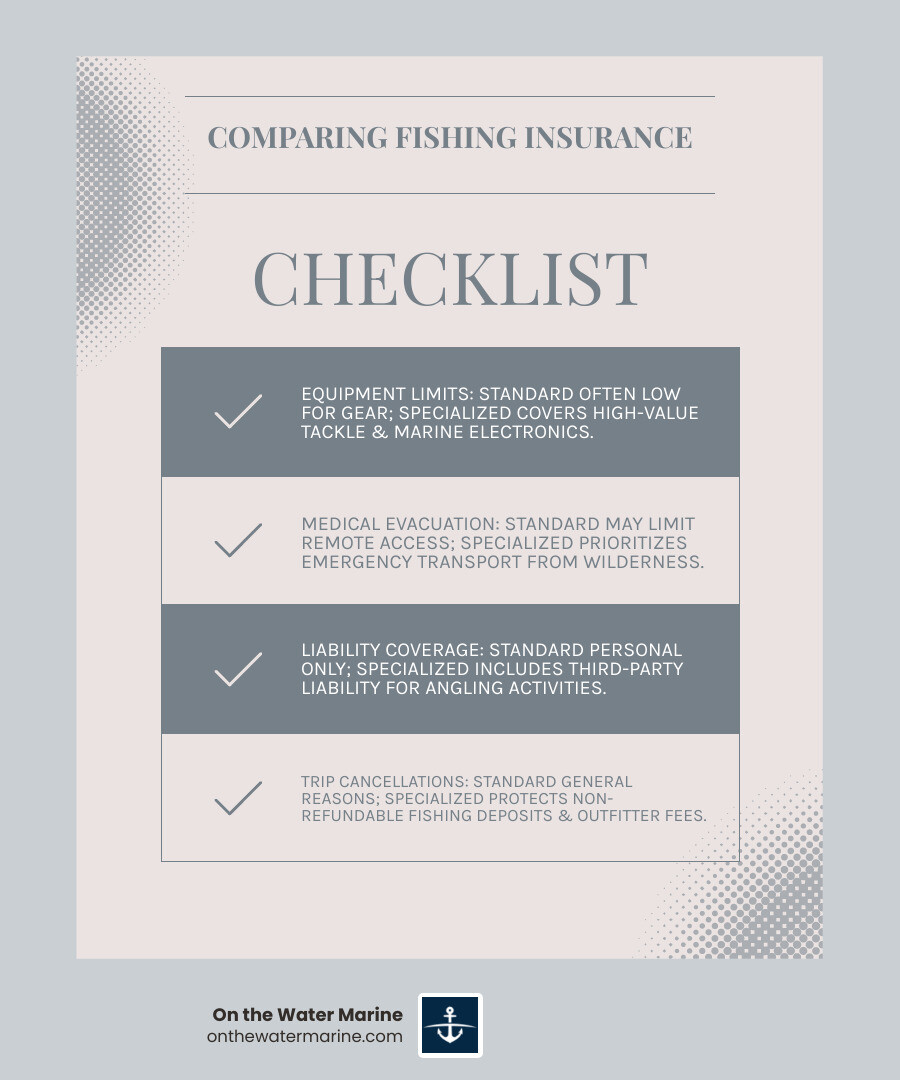
The distinction between standard travel insurance and specialized fishing coverage matters most when claims involve expensive equipment or professional activities. Home insurance policies typically limit coverage for fishing gear to a few hundred dollars, and many exclude commercial use entirely. If you’re traveling with $5,000 in rods, reels, and electronics, or if you’re a guide operating a charter, standard policies may leave significant gaps.
I’m Eric Fisher, founder and president of On The Water Marine Insurance, with over a decade of experience in marine risk management and a background in river rescue operations. While our primary focus is insuring 35’+ vessels, the principles of fishing trip insurance overlap significantly with the coverage considerations we guide clients through every day.
Understanding Fishing Trip Insurance and Why It Matters
Fishing trip insurance is a category of coverage designed to mitigate the various risks associated with recreational or professional fishing excursions. It is not always a standalone policy but may be an endorsement within a broader travel insurance plan, or a specialized policy for equipment or professional liability. The importance of this type of insurance often becomes clear when considering the significant financial commitments involved in many fishing trips.
Many premier fishing destinations, especially those involving guided tours or remote lodges, require substantial non-refundable deposits and full payment well in advance. If unforeseen circumstances, such as a family emergency or an act of God, necessitate the cancellation of a trip, these non-refundable payments could be lost. A robust travel insurance policy that includes trip cancellation coverage may offer financial recourse in such scenarios. This ensures that the investment in guide fees, accommodation, and other pre-paid expenses is protected.
Our experience suggests that a risk-aware approach to planning includes understanding the potential for unexpected events. Just as we recommend comprehensive coverage for larger vessels, we believe anglers benefit from carefully assessing their exposure when starting on a fishing trip. Protecting this investment is a vital part of preparing for any destination angling experience. For those with high-value sport fishing vessels, understanding how this specialized coverage integrates with existing marine policies is also a key consideration. More info about boat insurance for sport fishers can provide additional context on vessel-specific coverage.
Essential Coverage for Remote and International Expeditions
When planning a fishing trip, particularly to remote or international destinations, the scope of coverage needed often expands significantly beyond what a basic travel policy might offer. The distinction between domestic and international travel insurance is crucial here. International trips typically involve higher medical costs, more complex logistics for emergency services, and can expose travelers to different legal systems.
For trips to remote locations, such as a wilderness lodge in Québec or an isolated atoll, medical evacuation coverage is paramount. These areas often lack advanced medical facilities, meaning that a serious injury or illness could necessitate emergency transport to a more equipped hospital, potentially by air. Some operators, especially for highly specialized trips like those to Southern Seychelles Atoll or the Yokanga River, may even mandate proof of medical evacuation insurance as a prerequisite for participation. This is not merely a recommendation; it is often a critical safety measure.
Medical evacuation coverage is designed to cover the costs associated with emergency transport, which can be substantial. It helps ensure that, should a medical emergency arise, you can receive appropriate care without bearing the full financial burden of a specialized rescue and transfer. This coverage often works in conjunction with emergency travel assistance services, which can help coordinate medical care, communicate with family, and manage other logistical challenges during a crisis. Understanding these requirements is a key aspect of preparing for any serious angling expedition. If you’re planning a trip to a Québec outfitter, for instance, verifying their specific insurance requirements is a prudent step.
Protecting Your Investment with Fishing Trip Insurance
Beyond medical emergencies, fishing trip insurance often includes provisions to protect the overall financial investment in the trip itself. This might encompass several aspects of your travel.
Trip interruption coverage, for example, may provide reimbursement for unused portions of your trip or additional expenses incurred if you must cut your trip short due to a covered reason. This could include unexpected flights home or additional accommodation costs. Baggage delay benefits might offer compensation for essential items if your luggage, containing critical fishing gear or personal effects, is delayed by an airline. This allows for the purchase of necessary items until your bags arrive.
Many fishing trips involve significant non-refundable sportsman costs, such as guide fees, equipment rentals, or pre-purchased fishing licenses and tags. These are specific expenses that may not be covered under a general travel policy’s standard cancellation benefits. Specialized policies or endorsements can be custom to address these unique costs, ensuring that your financial outlay for the angling experience itself is protected. Travel inconvenience benefits often extend to cover situations like delayed departures, providing funds for unexpected overnight stays or meals. Some policies, for example, can include up to £10K in cancellation cover, offering substantial protection for your investment.
Equipment and Liability: Beyond the Standard Policy
For many anglers, especially those with high-value gear, the question of equipment coverage is a significant concern. Standard homeowner’s insurance policies may offer some coverage for personal belongings, but these often come with limitations that may not be suitable for specialized fishing equipment. These limitations might include low per-item limits, exclusions for items used in commercial activities, or deductibles that make small claims impractical.
When considering fishing trip insurance, we often look for policies that specifically address the unique value and nature of fishing tackle. This may involve coverage for personal property against loss, damage, or theft. The distinction between replacement cost and actual cash value is also important; replacement cost coverage may allow for the purchase of new gear, while actual cash value would account for depreciation.
Beyond equipment, liability is another critical component. Third-party liability coverage may protect you if you accidentally cause injury to another person or damage their property during your fishing activities. Personal accident coverage might offer benefits in the event of your own injury or accidental death. Legal expenses coverage could assist with legal costs if you are involved in a covered incident that leads to a lawsuit. For those who guide fishing trips, these liability considerations become even more complex, requiring specialized professional coverage. More info about fishing guide insurance provides further details on these professional needs.
Specialized Fishing Trip Insurance for High-Value Gear
Anglers often invest significantly in their equipment, from high-performance rods and reels to advanced marine electronics. Standard insurance policies often have limitations that make them unsuitable for covering these items adequately.
For example, generic baggage coverage on travel insurance plans often has per-item limits. While a Deluxe plan might offer $1,000 for the first item and $500 for subsequent items, an Essential plan may be limited to $500 for the first item and $250 for subsequent items. If you are traveling with several expensive rods, reels, or a specialized fish finder, these limits could leave you underinsured.
Specialized fishing trip insurance or endorsements can address these gaps by allowing for scheduled items, where specific high-value pieces of equipment are listed individually with their appraised value. This may provide more comprehensive coverage for theft from vehicles, accidental damage, or loss during transit or use. Such policies might also extend to cover marine electronics that are portable or temporarily removed from your primary vessel. For those with particularly expensive gear, extended valuables cover, potentially up to £1,000 per item, might be available as an add-on. We understand that this specialized angling gear is a significant investment, and ensuring it is appropriately protected is a common concern for our clients.
How Professional Requirements Differ for Guides and Charters
For professional fishing guides or charter operations, the insurance landscape shifts considerably compared to recreational anglers. The vessel, for a guide, is often their workplace, and the tackle their tools. This necessitates a more robust and specialized form of coverage.
Professional liability is a cornerstone of insurance for guides. This type of coverage may protect against claims arising from alleged negligence or errors in professional services. Beyond this, many policies for guides include unique features. Mechanical breakdown, for instance, is often an exclusion in standard recreational policies. However, for a guide whose livelihood depends on their vessel’s operational status, a specialized policy may cover this. Some policies specifically include mechanical breakdown, recognizing the critical nature of a functioning engine for a charter business.
Charter legal liability may offer an umbrella over another guide’s policy for booked charters, providing an additional layer of protection. Dockside liability is another crucial inclusion, potentially covering passenger injuries occurring before boarding or after disstarting the vessel. Shoreside coverage might extend protection to activities conducted on land, such as beach-based guiding or client interactions. Passenger safety is paramount, and these policies often include provisions for medical payments and other benefits for clients.
A comprehensive guided sport fishing policy may cover the boat, motor, equipment, and trailer, along with protection and indemnity (P&I) liability, pollution liability, and professional angler liability, which extends to activities beyond just operating the vessel, such as seminars or sport show appearances. Many resorts and government agencies often require guides to carry $1,000,000 or higher in liability limits. Our clients who operate charters understand that this is not merely about compliance, but about safeguarding their entire business. For a deeper dive into the financial aspects, you can consult our Fishing Guide Insurance Cost Guide.
Evaluating Policy Exclusions and Limitations
Understanding what a fishing trip insurance policy does not cover is as important as knowing what it does. Exclusions and limitations are integral parts of any insurance contract, and they can vary significantly between providers and policy types.
Common exclusions often include pre-existing medical conditions if not declared and specifically covered. Policies may also have limitations regarding extreme weather events, particularly if warnings were issued and ignored. Participation in professional competitions, especially if prize money or sponsorship exceeds a certain threshold (e.g., £200), may be excluded unless specifically endorsed. The policy language often specifies that activities are covered on a non-professional and non-competitive basis.
For vessel-related coverage, gradual deterioration, osmosis, or barnacle growth are typically excluded as these are considered maintenance issues rather than sudden, accidental damage. Claims arising from unlawful activities, such as illegal fishing, are almost universally excluded. Geographic limitations are also common; a policy might cover trips within a certain region (e.g., Europe, Worldwide excluding US & Canada) but not others. Even for activities like hunting, a general understanding of regional limitations is key, as seen in considerations for places to go hunting in Québec.
We always advise our clients to carefully review the policy wording. Nuances in policy language can determine whether a claim is payable. For instance, some policies may cover machinery breakdown under specific conditions (e.g., engine age, professional installation, adherence to maintenance schedules), while others may strictly exclude it. Similarly, fishing and diving gear might only be covered under very specific circumstances, such as loss due to fire, lightning, forcible entry, or total loss of the vessel itself. A thorough review of these exclusions can help prevent costly misunderstandings should an incident occur.
Navigating the Claims Process for Marine Incidents
When an unfortunate event occurs during a fishing trip, initiating a claim process requires careful attention to detail. The process typically begins with prompt incident reporting to your insurance provider. Timeliness is often crucial, as delays in reporting could complicate the claim.
Documentation is a key component of any claim. This may include photographs, police reports (for theft or malicious damage), medical records, receipts for damaged or lost equipment, and any other relevant evidence that supports your claim. For trip cancellations, documentation such as doctor’s notes or official notifications of an emergency would be required.
A fundamental principle in marine insurance, and indeed many other forms, is the duty to minimize loss. This means that after an incident, you are expected to take all reasonable steps to prevent further damage or loss, acting as if you were uninsured. For example, if your vessel sustains damage, securing it to prevent sinking or additional harm would be expected. Authorizing repairs or replacements without prior approval from your insurer, except for emergency measures to prevent further loss, is generally not advisable.
Proof of value for lost or damaged items is also critical. For high-value fishing gear, original receipts, appraisals, or detailed inventories can significantly aid the claims adjuster in determining appropriate compensation. Communication with the adjuster is ongoing throughout the process, and providing requested information promptly can help facilitate a smoother resolution. While simple claims for tackle might be settled in days, more complex claims, such as those involving negligence or significant personal injury, may take months to resolve. Understanding how to approach this process is vital for protecting your interests. For more general guidance on this topic, our article on Navigating a Boat Insurance Claim offers valuable insights.
Frequently Asked Questions about Fishing Trip Insurance
What is the difference between travel insurance and specialized fishing insurance?
The distinction between general travel insurance and specialized fishing trip insurance often lies in the depth and specificity of coverage. Standard travel insurance typically provides broad protection for your trip investment, covering aspects like trip cancellation, medical emergencies, and baggage delay. It may include fishing as one of many automatically covered activities, but often with general limits.
Specialized fishing insurance, or specific endorsements added to a travel policy, tends to be custom to the unique risks of angling. This may mean higher limits for expensive fishing equipment, specific coverage for tackle against theft or accidental damage (which often exceeds standard baggage limits), and potentially more nuanced liability protection related to fishing activities. For professional guides, this distinction is even greater, with policies designed to cover commercial operations, mechanical breakdown, and professional liability.
Does fishing trip insurance cover mechanical breakdown?
Coverage for mechanical breakdown can vary significantly depending on the type of policy. In many standard recreational travel insurance policies that include fishing, mechanical breakdown of a vessel or equipment is often an exclusion. These policies are generally focused on personal incidents and trip disruptions, not the operational integrity of equipment.
However, specialized policies, particularly those designed for professional fishing guides or charter operations, may include coverage for mechanical breakdown. These policies recognize that the operational reliability of a vessel is central to the business. Such coverage may come with specific conditions, such as the age of the engine, requirements for professional installation, and adherence to manufacturer’s maintenance recommendations. It is crucial to review the policy wording carefully to understand if, and under what conditions, mechanical breakdown is covered.
Is medical evacuation coverage necessary for domestic fishing trips?
While often highlighted for international or highly remote expeditions, medical evacuation coverage can be critically important even for domestic fishing trips, particularly if those trips venture into remote wilderness areas. In many such locations, local medical facilities may be basic or non-existent, lacking the resources to handle serious injuries or sudden severe illnesses.
If an angler sustains a significant injury or experiences a medical emergency in a remote domestic area, the cost of specialized transport (e.g., by helicopter or air ambulance) to the nearest appropriate medical facility can be substantial. These costs are often not covered by standard health insurance plans or general travel insurance policies. Medical evacuation coverage helps ensure that you can access necessary care without incurring crippling expenses, providing a layer of protection that is vital for any serious angler exploring less accessible fishing grounds.
Conclusion
Understanding the nuances of fishing trip insurance is a critical step for any serious angler, whether you’re starting on a personal adventure or operating a professional charter. From protecting your significant financial investment in a trip to safeguarding high-value equipment and managing potential liabilities, the right coverage can mitigate unforeseen risks.
As an independent marine insurance broker, On The Water Marine works to clarify these complex options. We often partner with specialized carriers to offer coverage that aligns with the unique demands of marine activities. Our role is to provide personalized service and expert guidance, helping you make informed decisions about your coverage. We aim to reduce misunderstanding and liability risk, ensuring that you are well-informed, not simply sold to.
If you’re insuring a 35’+ vessel and want to better understand your coverage options, you can request a quote here. We are here to help clarify your options and steer the complexities of marine insurance.
Related Articles

Navigating Marine Insurance: Clarity for Port St. Lucie Yacht Owners Most marine insurance problems do not appear when a policy is issued. They tend to surface [...]
Why Most Miami Boat Owners Don’t Find Coverage Problems Until It’s Too Late Boat insurance Miami Florida is often misunderstood until the moment a claim is [...]
Protecting Your Passion on Texas Waters Texas fishing guide insurance is specialized commercial coverage protecting professional guides from liability claims, equipment damage, and other business risks. [...]


