

Why Some Vessels Are Considered Hard to Insure
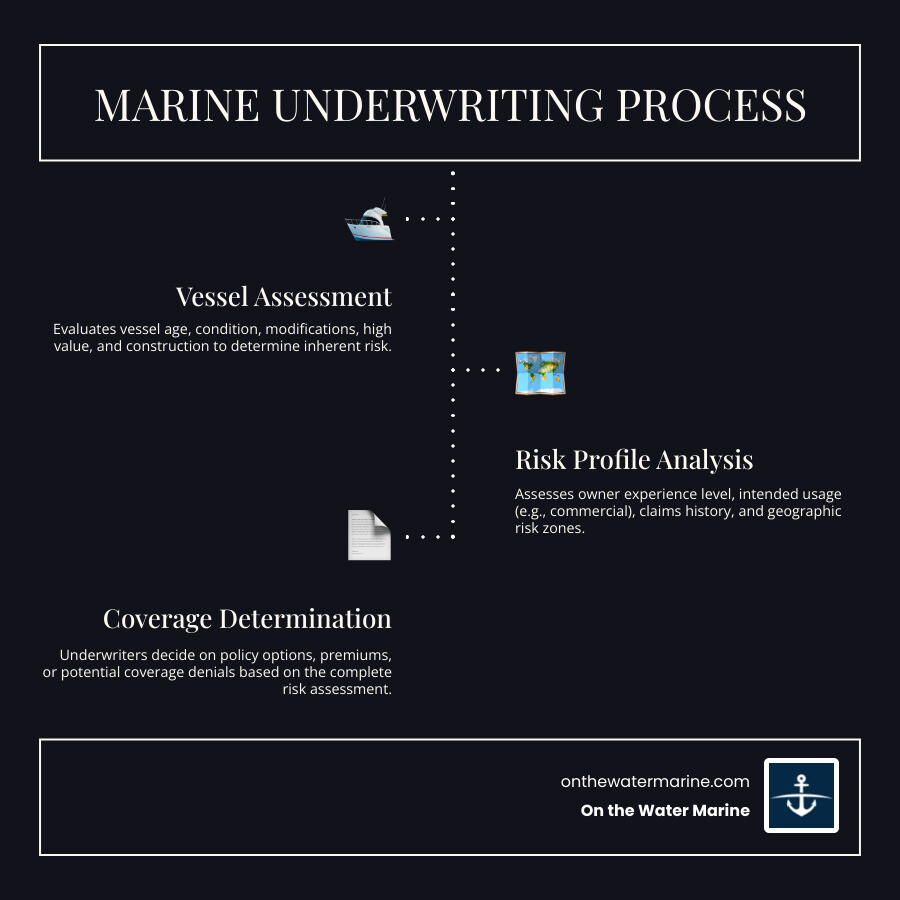
When a vessel is hard to insure, it typically means underwriters see liftd risk due to factors like age, condition, modifications, high value, specialized use, or the owner’s experience level. Marine insurance carriers assess each application against specific underwriting guidelines, and vessels that fall outside standard parameters may face coverage denials, higher premiums, or limited policy options.
Common factors that make a boat hard to insure include:
- Vessel age and condition — Older boats or those with deferred maintenance
- High-performance or modified builds — Engine upgrades, custom fabrication, or speed capabilities
- High value or exotic construction — One-of-a-kind vessels with specialized parts
- Commercial or charter use — Increased liability exposure and professional operations
- Owner experience gaps — Limited boating history relative to vessel size or complexity
- Geographic risk zones — Hurricane-prone areas, high theft regions, or restricted navigation limits
- Claims history — Frequent or high-value past claims
Most marine insurance problems don’t appear when a policy is bound — they appear when something goes wrong and the coverage isn’t structured to respond. Understanding what makes a vessel difficult to insure helps owners address risk factors proactively, whether that means improving the vessel’s profile, working with a specialist broker, or exploring non-standard markets.
I’m Eric Fisher, founder of On The Water Marine Insurance, and I’ve spent over a decade helping yacht owners steer coverage challenges for vessels that are hard to insure due to age, performance modifications, or unique risk profiles. Whether you’re operating a high-value cruiser, a custom build, or a vessel in a restricted geographic zone, understanding the underwriting perspective is the first step toward securing appropriate protection.
Navigating the Factors That Make a Vessel Hard to Insure
When considering marine insurance, the vessel itself is often the first point of evaluation. Underwriters carefully assess its inherent characteristics to determine the level of risk it presents. This assessment goes beyond simple aesthetics; it digs into the core aspects of the vessel’s construction, history, and current state.

A vessel’s age and its maintenance records are fundamental considerations. While insurers are prohibited from non-renewing a liability policy solely based on a vehicle’s age in some sectors, the age of a vessel can significantly impact its initial insurability. Older vessels, even those carefully cared for, may present unique challenges. For instance, parts for older engines or systems might be harder to source, potentially leading to longer repair times and higher costs. Similarly, certain hull materials, such as older wooden or ferro-cement constructions, may require specialized surveys and can be viewed differently by underwriters compared to modern fiberglass or steel hulls.
This is where a comprehensive marine survey becomes invaluable. A thorough survey provides a snapshot of the vessel’s condition, detailing its structural integrity, mechanical systems, and overall seaworthiness. This document can be a powerful tool in demonstrating to insurers that an older vessel is indeed well-maintained and a lower risk. We often recommend a recent, detailed survey, as it can significantly influence an underwriter’s decision. Understanding the concept of insurability from a theoretical perspective helps clarify why these factors are so critical: insurers need to be able to calculate and manage the risk effectively.
Managing Risks for Older Vessels That Are Hard to Insure
An older vessel doesn’t automatically mean it’s uninsurable, but it does mean a more proactive approach to risk management may be required. The overall condition of the vessel is paramount. Deferred maintenance, even minor issues, can quickly escalate into larger, more costly problems, making a vessel less attractive to insurers. Conversely, a history of consistent, professional maintenance can be a significant advantage.
Consider system upgrades as a way to improve insurability. Modernizing electrical systems, plumbing, or propulsion can mitigate risks associated with aging components and demonstrate a commitment to safety and reliability. For example, older vessels with outdated wiring might be perceived as a higher fire risk. Upgrading these systems can reduce that perceived risk.
When discussing coverage for older vessels, the distinction between Agreed Value vs. Actual Cash Value Boat Insurance becomes particularly relevant. For a well-maintained classic yacht, an agreed value policy often provides a more appropriate level of protection, as it sets the insured value at the outset, rather than depreciating it over time.
Why High-Performance and Custom Builds are Hard to Insure
High-performance vessels and custom builds often present a unique set of challenges for marine insurers. Engine modifications designed to boost speed or power can significantly alter a vessel’s risk profile. Higher speeds inherently increase the potential for accidents and the severity of damage in the event of a collision. Moreover, modified engines may not have the same reliability as factory-standard units, and replacement parts could be specialized and expensive, impacting repair costs.
Custom fabrication, whether it’s a unique hull design or bespoke interior finishes, also plays a role. While these features make a vessel distinctive, they can also make repairs more complex and costly. If a custom component is damaged, finding a matching replacement or an expert craftsman to repair it can be difficult and time-consuming. This increases the potential payout for an insurer.
In many cases, vessels that fall into the High Performance Boat Insurance category require specialized underwriting due to their inherent characteristics. Underwriters often consider the increased likelihood of claims, the potential for higher repair costs, and the specialized expertise required for both operation and maintenance.
How High Values and Specialized Use Impact Coverage
The value and intended use of a yacht are critical determinants of its insurability. A high-value vessel, whether a luxury yacht or an exotic custom build, inherently represents a greater financial risk for insurers.
The primary concern for insurers with high-value vessels revolves around replacement costs. Should a total loss occur, the payout could be substantial. This is compounded by the fact that many high-value vessels feature specialized parts and construction techniques. Finding replacement parts for a limited-production engine or exotic interior finishes can be challenging, expensive, and time-consuming, driving up potential repair or replacement costs. This mirrors the challenges seen in the automotive world, where “high-value and exotic cars present challenges due to high repair/replacement costs and niche markets requiring specialized insurers.”
The concept of Uninsurable Risk is relevant here, not because these vessels are truly uninsurable, but because their unique characteristics push the boundaries of what standard policies can accommodate. Insurers are generally wary of “risks that are rare but could result in potentially massive losses.” While a yacht fire is not rare, the cost associated with a high-value yacht fire can be massive. This is why Yacht Insurance is a specialized field, requiring underwriters who understand the intricacies of these significant assets.
The Complexity of Insuring One-of-a-Kind Vessels
One-of-a-kind vessels, including limited production models or highly customized yachts, introduce another layer of complexity. Their uniqueness, while desirable to owners, can translate into significant headaches for insurers. The difficulty arises from the scarcity of data for risk assessment. Unlike mass-produced vessels, there isn’t a large pool of historical claims data to draw upon, making actuarial calculations more challenging.
Repair difficulty is a major factor. If a unique hull or a custom-built system sustains damage, finding the specific expertise, materials, or replacement parts can be a global search. This often leads to extended repair times and inflated costs, both of which increase the insurer’s exposure. For vessels that prioritize Performance Boat Insurance needs, these complexities are often amplified, as high-performance components are frequently bespoke or sourced from specialist manufacturers.
Commercial and Charter Use Considerations
When a vessel transitions from private recreational use to commercial operation, such as chartering or serving as a fishing guide vessel, the risk profile changes dramatically. The primary concern for insurers becomes liability exposure. More passengers, increased usage hours, and the provision of services inherently lift the potential for accidents, injuries, or property damage claims.
Commercial operations often require different types of coverage and higher liability limits than a standard recreational policy. For instance, a vessel used for Fishing Guide Insurance Complete Guide will have specific requirements related to passenger liability, equipment coverage, and potential professional liability. The presence of a professional crew also adds considerations, including crew liability, workers’ compensation, and the need for specific endorsements to cover their professional duties. Underwriters will carefully review the operator’s qualifications, the vessel’s survey, and the specifics of the commercial operation to assess the overall risk.
The Role of Owner Experience and Geographic Risk
Beyond the vessel itself, the human element and the environment in which it operates play a pivotal role in determining insurability. Underwriters evaluate both the owner’s proficiency and the inherent risks of the vessel’s primary cruising grounds.
A driver’s record (driving, insurance, credit) plays a significant role in vehicle insurability, and a similar principle applies to marine insurance. An owner’s claims history, for example, can be a red flag. “Most insurance companies will be hesitant to provide coverage if you have a history of excessive claims — more than two claims in the last three years.” Such claims typically stay on an individual’s record for “five to seven years,” indicating a pattern of risk that underwriters must consider.
Navigation limits, which define the geographical area where a vessel is insured to operate, are crucial. Operating outside these limits could void coverage. Similarly, the vessel’s home port and cruising regions are assessed for geographic risk. This includes factors like hurricane zones, areas with high theft rates, or regions known for challenging sea conditions. For instance, a vessel routinely operating in a hurricane-prone area will face different underwriting considerations than one confined to an inland lake.
How Your Boating Resume Influences Underwriting
An owner’s boating experience, often referred to as their “boating resume,” is a critical factor in marine underwriting, especially for larger or more complex vessels. Underwriters want to ensure the operator is competent and capable of handling the vessel safely. This involves a “vessel size-up,” where your experience is evaluated against the size, type, and capabilities of the yacht you intend to operate.
Formal training and certifications, such as those from the U.S. Coast Guard, Royal Yachting Association (RYA), or other recognized maritime institutions, can significantly improve your insurability. These demonstrate a commitment to safety and a foundational understanding of seamanship. For those new to yacht ownership or moving up to a larger vessel, building a Building a Boater Experience Resume for Boat Insurance is a proactive step. Similarly, just as a “lack of driving experience” can make a new driver hard to insure, limited boating experience relative to the vessel can make a yacht owner hard to insure. We often advise new owners, or those acquiring their Your First Boat: Your Guide on Boat Insurance, to consider additional training or mentorship to bolster their resume.
Geographic Areas Where Coverage May Be Restricted
The geographic location where a vessel is primarily docked and where it typically cruises has a profound impact on its insurability and the terms of its policy. Certain regions are inherently riskier than others, and insurers adjust their underwriting accordingly.
One major concern is storm frequency, particularly in hurricane-prone areas. Regions like the Gulf Coast and much of Florida Boat Insurance territory face annual hurricane seasons, which significantly increase the risk of damage. Insurers often impose specific requirements or restrictions for vessels in these zones, including mandatory hurricane preparedness plans, haul-out clauses, or higher deductibles during named storms. Our guide on the 2024 Hurricane Season outlines some of these critical considerations.
Theft rates also play a role. Just as “living in an area with high theft and vandalism rates can lead insurers to deny coverage” for vehicles, marine insurers consider local crime statistics. Marinas or anchorages known for high rates of vessel theft or equipment pilfering may lead to higher premiums or requirements for improved security systems. In some extreme cases, certain international waters or specific ports might be excluded from standard navigation limits due to geopolitical instability or liftd piracy risks.
Options When Traditional Marine Coverage is Denied
If your vessel is deemed hard to insure by traditional marine insurance markets, it can be a frustrating experience. However, a denial from one carrier does not necessarily mean you are without options. Specialized avenues exist to secure coverage for unique or high-risk marine assets.
One common solution is the surplus lines market. Unlike admitted carriers that are licensed in specific states and subject to strict rate and form regulations, surplus lines carriers offer more flexibility. They can craft bespoke policies for risks that standard markets are unwilling or unable to cover. This often includes complex vessels, unusual uses, or owners with unique circumstances. While these policies may sometimes be more expensive or have different terms, they provide a vital avenue for coverage. As noted in other insurance sectors, “if you have to resort to state risk pools or non-standard insurance, it reduces your choices and is more expensive.” In marine, surplus lines are often simply the appropriate market for unique risks, not necessarily a ‘last resort’ in the same way.
Finding these specialized markets often requires working with an experienced marine insurance broker who has access to a wide range of carriers, including those in the surplus lines sector. Organizations like AIPSO, which manages “assigned risk” programs for auto insurance, illustrate the concept of a market of last resort, but for marine, the surplus lines market serves a similar function for unique risks, offering custom solutions rather than a one-size-fits-all approach. We aim to act as that bridge for our clients.
Understanding Surplus Lines and Specialty Carriers
The surplus lines market is a crucial component of the marine insurance landscape for vessels that are hard to insure. These carriers, often referred to as specialty carriers, operate with greater flexibility in their underwriting guidelines and policy forms. This flexibility allows them to assess and cover risks that fall outside the rigid parameters of standard, admitted policies.
The trade-off for this flexibility may include higher premiums, more specific exclusions, or “higher deductibles for physical damage coverage.” Policy language in the surplus lines market can differ significantly from standard policies, emphasizing the importance of a thorough review. Understanding Marine Underwriting Forms is essential, as these forms can be highly customized to the specific risk of the vessel. For example, a policy for a highly modified performance yacht might have very specific limitations on speed or navigation, or require improved safety equipment.
Steps to Improve a Vessel’s Insurability Profile
If your vessel is considered hard to insure, there are proactive steps you can take to improve its insurability profile and potentially secure more favorable terms. The goal is to reduce the perceived risk in the eyes of an underwriter.
- Safety Upgrades: Investing in modern safety equipment can make a significant difference. This could include updated fire suppression systems, advanced navigation electronics, improved bilge pump systems, or improved communication equipment. Demonstrating a commitment to safety can positively influence an underwriter’s assessment. Our Boating Safety 101 guide offers a starting point for these considerations.
- Security Systems: For vessels in areas with higher theft risks, installing robust security systems can be beneficial. This might include advanced alarm systems, GPS tracking devices, or improved physical deterrents. Just as “installing a security system to improve chances of getting insured in high-crime areas” applies to homes, it holds true for yachts.
- Professional Maintenance: Maintaining a detailed log of all maintenance, repairs, and upgrades performed by certified professionals showcases responsible ownership and the vessel’s good condition.
- Operator Training: For owners with limited experience relative to their vessel, pursuing formal training, certifications, or hiring experienced captains for a period can significantly improve their “boating resume” and reduce perceived operator risk.
- Regular Surveys: Keeping surveys current, especially for older vessels, provides underwriters with up-to-date information on the vessel’s condition.
By taking these steps, you are not only making your vessel safer but also presenting a more attractive risk to potential insurers.
Frequently Asked Questions about Hard to Insure Boats
Why would a carrier deny coverage for a well-maintained older boat?
Even a carefully maintained older boat can sometimes be considered hard to insure by certain carriers, and this is often rooted in their specific underwriting guidelines and risk appetite. While an older boat might be structurally sound and aesthetically pleasing, its age can still present inherent risks that some insurers are not willing to take on.
Factors such as the availability of replacement parts for vintage engines or systems, the potential for unforeseen age-related failures (even with good maintenance), or the lack of modern safety features and construction standards can make an underwriter hesitant. For instance, if a rare, older engine fails, the cost and time to source and install a replacement could be significantly higher than for a newer, more common model. Additionally, some carriers simply have a corporate policy that limits the age of vessels they will insure, regardless of condition. This is where a detailed marine survey becomes crucial, as it provides objective evidence of the vessel’s current condition, which can help overcome some of these age-related concerns.
How do previous insurance claims affect my ability to get a new policy?
Your previous insurance claims history can significantly impact your ability to secure a new marine insurance policy, especially if your vessel is already considered hard to insure. Underwriters use claims data to identify patterns of risk and predict future losses. “Most insurance companies will be hesitant to provide coverage if you have a history of excessive claims — more than two claims in the last three years.” These claims, whether for damage, liability, or theft, typically “stay on your record for five to seven years.”
The frequency and severity of past claims are both critical. A history of multiple small claims might indicate a pattern of negligence or insufficient maintenance, while a single large claim could signal a high-risk event. Underwriters evaluate these “loss frequency” and “risk patterns” to determine if you, as an owner, present an liftd likelihood of future claims. While one claim might not be a deal-breaker, a series of claims can lead to higher premiums, restricted coverage options, or even denial of coverage. Understanding Will filing an insurance claim affect my premium? helps clarify this impact.
Can I get insurance for a boat with significant engine modifications?
Insuring a boat with significant engine modifications can indeed be challenging and may classify it as hard to insure. Engine modifications, especially those that increase horsepower or speed beyond the manufacturer’s original specifications, introduce several concerns for underwriters.
Firstly, there’s the increased risk of mechanical breakdown. Modified engines may operate outside their intended parameters, potentially leading to premature wear or catastrophic failure. This directly impacts the availability and terms of mechanical breakdown coverage. Secondly, improved speed capabilities inherently raise the potential for high-speed collisions or accidents, leading to more severe damage and higher liability exposure. “Modifications can increase risk by affecting safety, reliability, repair costs, and theft likelihood.”
Many standard policies may exclude coverage for damage resulting directly from such modifications or may require specific endorsements that come with higher premiums and stricter conditions. Underwriters will often require detailed documentation of the modifications, including professional installation and dyno tests, to assess the risk accurately. In some cases, only specialty carriers in the surplus lines market may be willing to offer coverage for such highly customized vessels.
Conclusion
Navigating the complexities of marine insurance, particularly for vessels that are hard to insure, requires a nuanced understanding of risk and the specialized markets available. Whether due to age, high performance, unique construction, or specific geographic factors, the key lies in proactive risk management and informed decision-making.
We understand that securing appropriate coverage for your cherished yacht can seem daunting. For complex or high-value marine risks, working with a specialist can help clarify options. If your situation isn’t straightforward, a professional review may be worthwhile. We are here to help you understand your options and connect you with the right solutions.
Related Articles

Navigating Marine Insurance: Clarity for Port St. Lucie Yacht Owners Most marine insurance problems do not appear when a policy is issued. They tend to surface [...]
Why Serious Anglers Need to Understand Insurance Before Casting Off Fishing trip insurance protects your financial investment in guided expeditions, remote charters, and international angling trips [...]
Why Most Miami Boat Owners Don’t Find Coverage Problems Until It’s Too Late Boat insurance Miami Florida is often misunderstood until the moment a claim is [...]


