

Why Personal Watercraft Insurance Costs Vary More Than You Think
Most marine insurance issues don’t show up when a policy is bound — they show up when something goes wrong and the owner assumes the PWC is insured “the same way” as the yacht. For 35’+ yacht owners, personal watercraft are often treated as a simple add-on, but the coverage details can be very different depending on how the PWC is listed, who operates it, and where it’s used.
Personal watercraft insurance cost varies widely by carrier, even when the PWC looks identical on paper. That’s usually because underwriting is focused less on the purchase price and more on liability exposure, operator controls, navigation limits, storage, and how the policy defines the watercraft.
Quick Answer: What Typically Influences Personal Watercraft Insurance Cost?
- Vessel characteristics: Engine size, performance tier, and any non-factory modifications
- Geographic and weather risk: Coastal storm exposure and local loss history
- Operator profile: Age, experience, training, and prior incidents
- Coverage structure: How liability and physical damage are written and valued
- Usage patterns: Navigation boundaries, seasonal use, and storage/launch method
This is often misunderstood: a lower premium can reflect narrower coverage language, higher deductibles, stricter operator requirements, or exclusions that only become obvious during a claim review. The goal for most serious yacht owners isn’t to “find the lowest rate” — it’s to avoid gaps that could create preventable disputes later.
I’m Eric Fisher. Over the past decade in marine insurance underwriting and brokerage, I’ve reviewed thousands of personal watercraft policies and seen how small wording differences can materially change how a loss is handled. Below is a practical way to think about personal watercraft insurance cost drivers so you can evaluate protection first and price second.
What Drives the Cost of Personal Watercraft Insurance?
When we evaluate a personal watercraft insurance cost, we are essentially looking at a risk assessment. Unlike standard auto insurance, marine underwriters must account for a fluid environment where environmental hazards, high-performance capabilities, and multi-operator usage intersect. For owners of larger yachts who carry personal watercraft (PWC) as tenders, the complexity increases.
Carriers assess the “liability footprint” of the vessel. Personal watercraft were involved in roughly 22% of all reported boating accidents in 2020, a statistic that weighs heavily on how premiums are calculated. Because these vessels are lightweight and capable of high speeds, the potential for bodily injury or property damage is statistically higher than that of a displacement-hull cruiser.
The way you use the vessel also dictates the premium. A PWC used primarily for local lake recreation presents a different risk profile than one frequently navigated in busy coastal inlets or stored on the deck of a 60-foot motoryacht. Underwriters consider the likelihood of theft, the density of watercraft traffic in your primary mooring area, and the specific safety features of the vessel itself.

How Vessel Performance and Modifications Influence Premiums
The personal watercraft It’s not a “boat” and is typically used by standing, sitting, or kneeling on it as you move it through the water. Because apersonal watercraftis lightweight and small, it can have different legal requirements than other types of vessels. definition is broad, covering everything from entry-level recreational models to luxury performance machines.
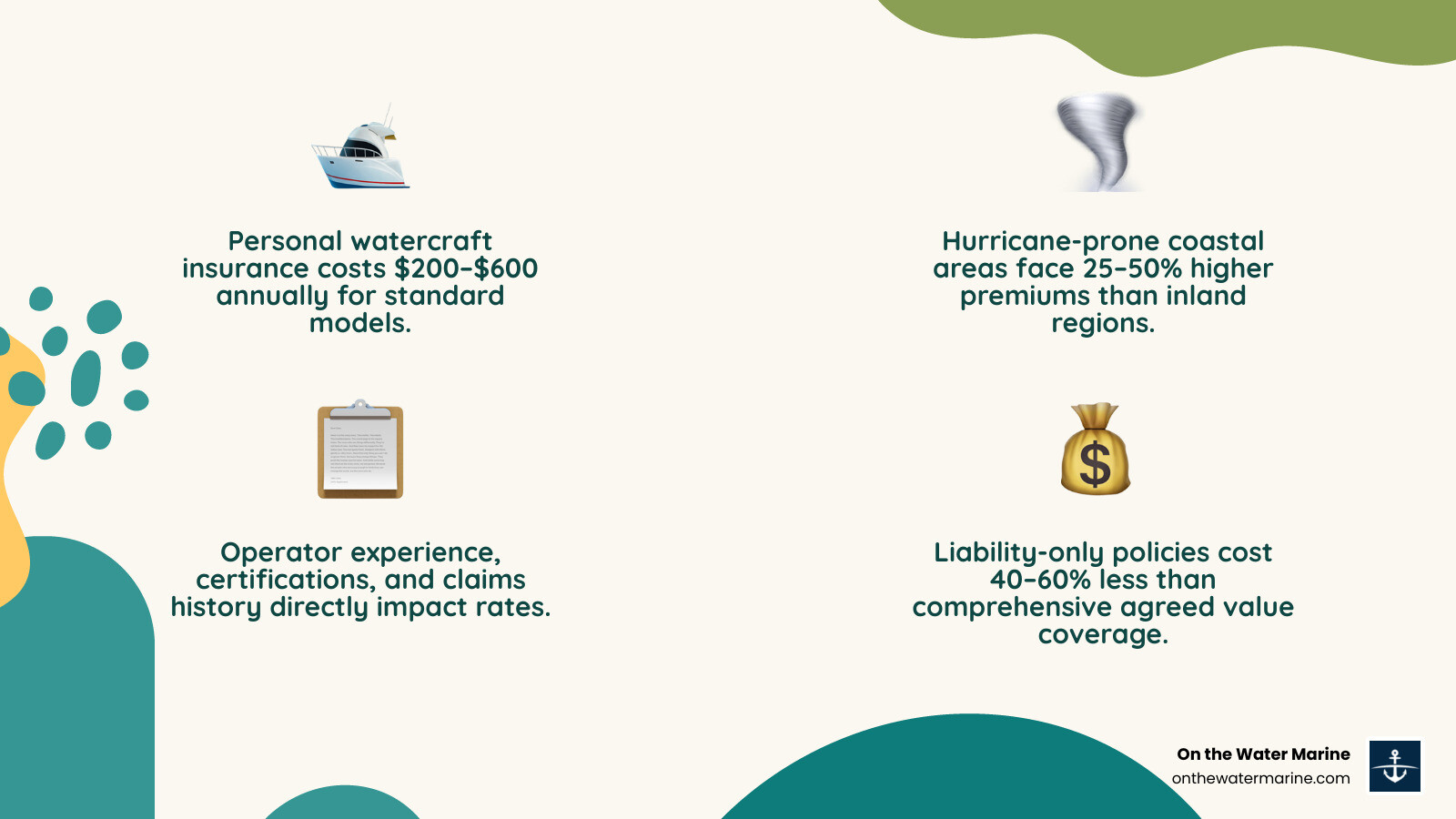
Engine size and performance tiers are primary cost drivers. High-performance models, often producing 300 horsepower or more, can see insurance rates that are 60% to 80% higher than standard recreational units. These vessels are categorized by their power-to-weight ratio, which directly influences the premium.
- Entry-Level Models: Generally valued between $8,000 and $15,000, these often attract the most accessible rates.
- High-Performance Models: Often valued up to $30,000, these units frequently require specialized underwriting due to their top speeds.
- Aftermarket Modifications: Modifications intended to increase speed or maneuverability may result in coverage denial or significantly higher premiums. Most standard policies exclude vessels that have been modified beyond factory specifications.
The Impact of Operator Experience and History
Your personal history is just as important as the vessel’s specifications. New boaters, defined as those with less than five years of experience, may face premiums that are 15% to 25% higher than seasoned operators. Furthermore, Will Credit Rating Change Insurance Rates? is a common question; in many states, carriers use insurance scores, which include credit history, to help determine the likelihood of a claim.
A clean claims history is vital. A single major violation or claim can increase premiums by 25% to 50%, while a BWI (Boating While Intoxicated) conviction may lead to an outright denial of coverage. Conversely, completing a certified boating safety course through the Coast Guard Auxiliary or Power Squadron can often result in a 10% to 15% discount, as it demonstrates a commitment to risk mitigation.
Geographic Risk and Navigation Boundaries
Where you keep and use your PWC can materially impact personal watercraft insurance cost. Coastal areas from Texas through the Southeast often bring added storm exposure, higher theft frequency in certain marinas, and more congested waterways — all of which may influence underwriting.
Navigation limits are also where differences matter. Depending on the policy language, a PWC may be restricted to specific lakes, bays, or a defined distance from shore. If the PWC is operated outside those boundaries, coverage may be limited or unavailable for that loss, even if the incident itself looks “ordinary.”
For yacht owners who travel, the PWC’s navigation terms are worth checking alongside the yacht’s. In many cases, the yacht policy’s cruising range does not automatically apply to the tender or PWC, and the mismatch isn’t discovered until there’s a claim question.
If you’re insuring a 35’+ vessel and want to better understand how navigation limits, named operators, and storage requirements affect your options, a professional review may be worthwhile.
Understanding Coverage Structures: Liability and Physical Damage
Choosing between Agreed Value vs. Actual Cash Value Boat Insurance is perhaps the most significant decision impacting both your premium and your protection.
- Agreed Value: The insurer and the owner agree on a set value for the vessel at the start of the policy. In the event of a total loss, the insurer pays that amount without depreciation. This typically adds 10% to 15% to the premium but is often preferred for newer or high-value models.
- Actual Cash Value (ACV): This coverage accounts for depreciation. While it results in a lower annual premium, the payout in the event of a loss may be significantly less than the cost to replace the vessel.
Liability coverage is the foundation of any policy. It may cover bodily injury to others, property damage, and legal defense costs. While liability-only policies are often 40% to 60% less expensive than full coverage, they leave the owner responsible for the cost of repairing or replacing their own PWC if it is damaged by weather, theft, or an at-fault accident.
Policy Exclusions and Maintenance Requirements
Understanding the “fine print” is where many owners find the most value. Most Personal Watercraft Insurance: Get a free personal watercraft Insurance quote guides will note that certain activities are standard exclusions.
- After-Dark Operation: Many PWC policies specifically exclude coverage for incidents occurring between sunset and sunrise.
- Racing and Competition: Unless specifically endorsed, participating in any organized race or speed contest usually voids coverage.
- Maintenance Standards: Insurers often require proof of proper winterization and storage. If a claim arises from a frozen engine block or lack of maintenance, the carrier may deny the claim based on “wear and tear” exclusions.
Documentation of professional maintenance and secure storage can be vital when filing a claim. Carriers often look for evidence that the owner took reasonable steps to prevent foreseeable damage.
Managing Premium Drivers Without Creating Coverage Gaps
When the goal is reducing misunderstanding (and avoiding avoidable claim friction), it helps to separate premium drivers from coverage decisions. In many cases, the biggest problems occur when an owner changes deductibles, removes physical damage, or relies on assumptions about permissive operators without confirming the policy language.
Here are a few areas that commonly influence personal watercraft insurance cost, with tradeoffs that are easy to miss:
- Deductibles: Higher deductibles may reduce premium, but they also increase what you retain on a loss. The right choice often depends on how the PWC is stored, how frequently it’s used, and how comfortable you are absorbing smaller losses.
- Bundling and policy placement: Some owners place the PWC with the same carrier as the yacht; others don’t. Either approach can work, but coverage definitions, operator requirements, and navigation terms can differ significantly by carrier.
- Lay-up / seasonal restrictions: Some policies may allow a lay-up period credit when the PWC is stored and not operated. This can be helpful, but it typically comes with conditions (location, secure storage, dates, and sometimes winterization expectations).
A practical way to evaluate cost is to confirm, in writing, the items that most often drive disputes: who can operate the PWC, where it can be used, how it’s valued, and what exclusions apply to storage, theft, and after-hours operation. Once those are clear, premium comparisons are more meaningful.
If your situation isn’t straightforward — for example, multiple operators, travel between states or to the Bahamas, or a PWC carried on a yacht — working with a specialist can help clarify options before you bind coverage.
Frequently Asked Questions
Is Insurance Legally Required for Personal Watercraft?
The legal requirement for PWC insurance varies by state. While only a few states mandate insurance for all motorized watercraft, many require minimum liability limits for operation on public waters. Furthermore, if the vessel is financed or leased, the lending institution will almost certainly require full physical damage coverage. Even when not legally mandated, FAQ: How much does boat insurance typically cost? is a small price to pay compared to the potential liability of an at-fault accident involving a swimmer or another vessel.
Does My Policy Extend to Other Operators?
In many cases, PWC policies include “permissive use” clauses, which may extend coverage to friends or family members who use the vessel with your permission. However, this is often subject to age and experience restrictions. Some policies may exclude operators under the age of 16 or require all regular operators to be specifically named on the policy. It is important to note that FAQ: Will filing an insurance claim affect my premium? even if someone else was operating the vessel at the time of the incident.
How Does Winter Storage Affect My Premium?
Many marine policies are annual contracts that provide year-round protection, including during winter storage. This is crucial because risks like theft, fire, or building collapse still exist when the vessel is out of the water. Using The Smarter Way to Shop for Boat Insurance often involves looking for “lay-up warranties,” which provide a premium credit for months the vessel is not in use, while maintaining comprehensive protection against non-operational risks.
Conclusion
Personal watercraft insurance cost is best understood as a reflection of risk controls and policy structure — not just the PWC’s value. For 35’+ yacht owners, the more important question is usually whether the policy language matches how the PWC is actually used: operators, navigation, storage, and the way physical damage is valued.
If you’re insuring a 35’+ vessel and want to better understand your coverage options for tenders and personal watercraft, you can request a quote here: https://onthewatermarine.com/boat-insurance/.
Related Articles

What Is Commercial Marine Insurance — and Why It Matters for Your Business Commercial marine insurance is a category of specialized coverage designed to protect businesses [...]
What Florida PWC Owners Often Miss Until a Claim Happens Most insurance problems don’t show up when a policy is purchased — they show up after [...]
Why “Boat Insurance Florida Cost” Is Often a Misleading Starting Point Most marine insurance problems don’t appear when a policy is bound — they appear when [...]


