

What Florida PWC Owners Often Miss Until a Claim Happens
Most insurance problems don’t show up when a policy is purchased — they show up after a collision, a theft, or a storm, when an owner realizes a policy didn’t respond the way they assumed it would.
This guide focuses on personal watercraft insurance Florida through that lens: preventing common misunderstandings that can create financial exposure. In many cases, Florida law may not require a dedicated PWC policy to register or operate — but lenders, marinas, and storage facilities may. And even when insurance is truly optional, liability and physical damage gaps can still exist depending on the policy language.
| Topic | Key Fact |
|---|---|
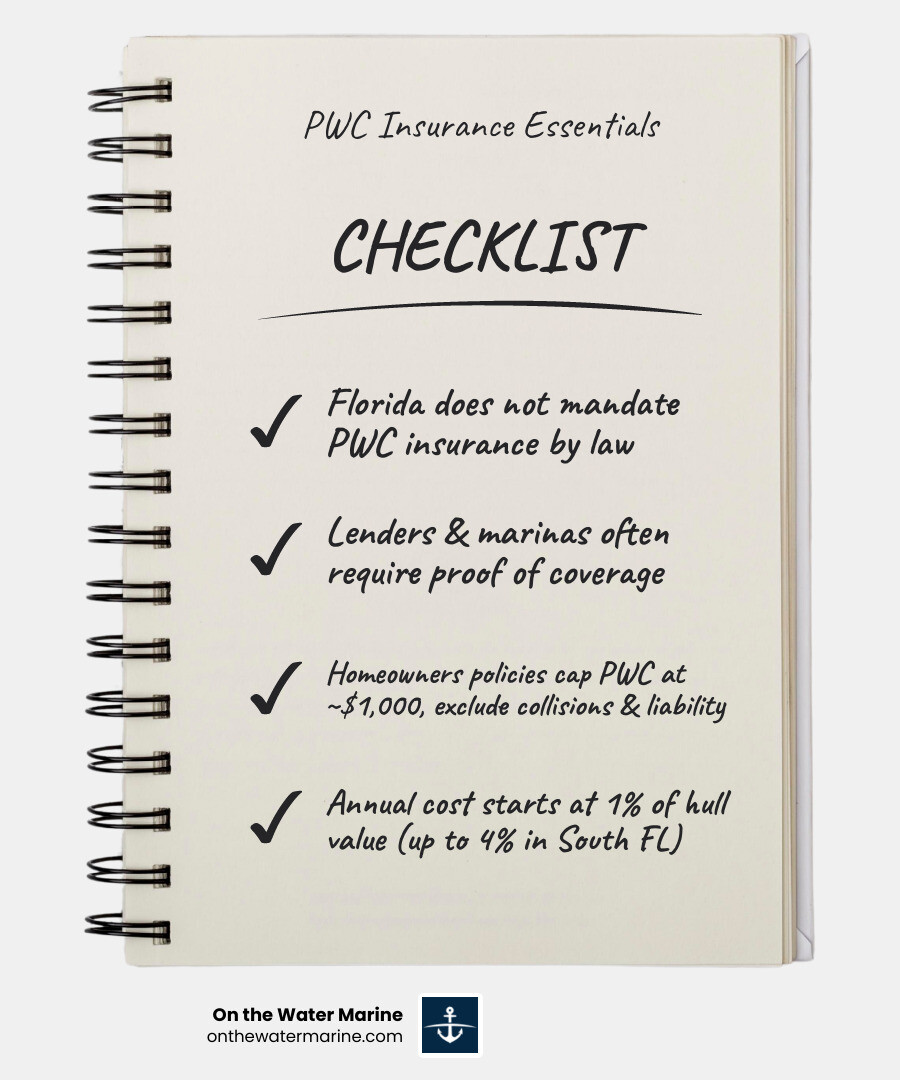
| State requirement | Florida typically does not mandate PWC insurance by law |
| When it’s required | Lenders and many marinas may require proof of coverage |
| Homeowners policy | Typically provides limited watercraft coverage; liability and collision may be excluded depending on the form |
| What drives premiums | Premiums vary based on hull value, location, operator profile, and storm/theft exposure |
| Common coverages | Liability, physical damage, medical payments, uninsured/underinsured boater (varies by carrier) |
| Florida-specific risks | Named storms, theft/transport exposure, crowded waterways, year-round use |
| Accident reporting | U.S. Coast Guard reporting may apply based on injury, fatality, or damage thresholds |
Florida has more registered boats than any other state — over one million. That density matters because many PWC incidents involve congestion, docking/launching areas, and unfamiliar operators.
Many owners also assume their homeowners insurance fills the gap. In practice, homeowners policies often have strict horsepower/length limits and may exclude liability for certain powered watercraft. The details vary, and that’s where differences matter.
I’m Eric Fisher, founder of On The Water Marine Insurance and a former firefighter-paramedic with river rescue experience. I’ve spent over a decade helping owners evaluate marine policies across the country, including the practical realities that show up in personal watercraft insurance Florida when a loss occurs.
Understanding Personal Watercraft Insurance Florida Requirements

When navigating the legalities of the Sunshine State, many owners are surprised to learn that Florida statutes do not strictly mandate Florida Boat Insurance for recreational vessels, including personal watercraft (PWC). However, viewing insurance as “optional” is often a misconception that disappears the moment you attempt to finance a vessel or secure a spot at a local dock.
While the state may not require a policy to register your Jet Ski or Sea-Doo, third parties often will. If you have a loan on your watercraft, your lender may require physical damage coverage to protect their investment. Furthermore, if you plan to utilize a “dry stack” facility or a marina slip, your contract may mandate a minimum level of liability coverage—often reaching substantial six-figure limits—to protect the facility from damage you might cause.
Why Homeowners Policies Often Fall Short for personal watercraft insurance Florida
It is a common belief that a homeowners policy provides sufficient protection for a PWC. In reality, these policies often contain strict limitations. Most standard homeowners forms may cap property damage for watercraft at a very low limit, sometimes as little as a nominal fixed amount or a small percentage of the home’s value.
More importantly, many homeowners policies may exclude liability coverage for powered watercraft altogether once they exceed a certain horsepower or length. This creates a significant “liability gap” where you could be personally responsible for medical bills or property repairs following an accident. To understand the nuances of these limitations, it is helpful to learn about boat insurance coverage in Florida through a specialized lens.
Contractual Obligations and Marina Rules
In Florida’s crowded coastal hubs, marinas act as the gatekeepers of the water. Even if you own your PWC outright, you may need to provide proof of insurance to sign a slip agreement. These private contracts are often more stringent than state law. Additionally, if you are transiting through certain managed waterways or participating in organized events, insurance may be a prerequisite for entry. You can find more details on these nuances in our guide on whether boat insurance is required in Florida.
Core Coverage Areas That Often Matter Most on Florida Waterways
A policy written for personal watercraft insurance Florida may be built around a few coverage areas, often similar to those found in Marine Guide insurance resources. What’s included (and how it’s defined) can vary significantly by carrier, which is why it’s worth reading beyond the declarations page.
- Bodily Injury Liability: May respond if you are found responsible for injuring another person. The scope of defense costs, exclusions, and operator requirements often depends on the policy language.
- Property Damage Liability: May apply if you damage another boat, PWC, dock, or marina property. Sub-limits and “property in your care, custody, or control” language can change how claims are handled.
- Medical Payments: May help with immediate medical costs for the operator and passengers, regardless of fault, subject to the limit selected.
- Uninsured/Underinsured Boater: Because Florida does not require operators to carry insurance, this may be an important coverage to review. Availability and requirements can differ by carrier.
Choosing Liability Limits: Why the Jet Ski Value Isn’t the Main Issue
Liability limits may be selected based on your overall exposure, not the market value of the PWC. In Florida, injuries can become expensive quickly, and lawsuits may involve more than just the people on the watercraft.
If you’re unsure how to think about limits, the practical approach is to evaluate:
- How and where the PWC is used (busy inlets vs. inland lakes)
- Who operates it (household members, guests, age/experience)
- What assets you’re trying to protect
For broader context, many owners find it helpful to review how carriers structure boat insurance coverage in Florida before deciding what “enough” looks like.
Environmental and “Hidden” Exposures to Ask About
Some marine policies may include (or offer) items like fuel spill liability or wreckage removal. Whether these apply — and when — depends on the wording and the event.
This is one of the most common areas where owners assume a policy will respond, but later learn the triggering language is narrower than expected.
Navigating Florida-Specific Risks: Hurricanes and Theft
Florida presents two major risks that drive premium costs and policy language: tropical cyclones and high rates of theft.
Hurricane Preparedness and Policy Language
In Florida, “Named Storm” deductibles are often standard. These are frequently higher than your standard hull deductible and may apply specifically when a loss is caused by a hurricane or tropical storm. Some policies include “hurricane haul-out” provisions, which may reimburse a portion of the cost to professionally move your PWC to a safer location when a storm warning is issued. Understanding these precautionary measures is vital for anyone living in high-risk zones like Southwest Florida.
Theft Prevention and Equipment Coverage
PWCs are highly portable, making them prime targets for theft. A comprehensive policy typically covers the theft of the unit itself, but you should also verify coverage for the trailer and any added electronic gear. Many owners spend thousands on GPS units or high-end sound systems; these often require specific scheduling or “personal effects” endorsements to be fully accounted for. For those in high-traffic areas, reviewing a Port St. Lucie boat insurance guide or similar regional resource can highlight local theft trends.
Valuation Methods: Agreed Value vs. Actual Cash Value
How much will the insurance company pay if your PWC is totaled? The answer depends on the valuation method chosen at the start of the policy.
- Agreed Value: You and the insurer agree on a set value for the vessel (usually the purchase price or a professional appraisal). If a total loss occurs, that is typically the amount paid, regardless of depreciation, subject to policy terms. This provides more certainty but often comes with a slightly higher premium.
- Actual Cash Value (ACV): This method factors in depreciation. If your five-year-old WaveRunner is stolen, the insurer may pay what it was worth on the market at the time of the theft—not necessarily what you paid for it.
The Impact of Depreciation on Claims
Choosing ACV may lower your annual premium, but it can lead to a significant “out-of-pocket” gap if you need to replace the vessel. For newer or high-value PWCs, Agreed Value is often the preferred choice among risk-aware owners. You can see how these choices impact your bottom line in our boat insurance Florida cost guide.
What Drives Premium Differences for Personal Watercraft Insurance in Florida
Premiums for personal watercraft insurance Florida can vary widely, and focusing only on the number can lead to the wrong coverage decision.
Cost may be influenced by factors such as:
- Vessel specifications: Performance characteristics, model type, and replacement complexity can affect underwriting.
- Operator profile: Boating experience, claims history, and how the carrier defines an “approved operator” may impact terms.
- Use and storage location: Coastal exposure, theft risk, and whether the unit is stored on a trailer, lift, or facility can all matter.
- Storm exposure: Named-storm deductibles and storage requirements may affect both pricing and claim response.
- Safety education: Completing a state-approved course may help in underwriting, and it often reduces real-world loss frequency.
Lower premiums often involve tradeoffs — higher deductibles, fewer endorsements, narrower operator language, or valuation methods that shift more risk back to the owner.
If your situation isn’t straightforward (financing, storage requirements, high-value accessories, or frequent guest operators), a professional review may be worthwhile. You can also reference the FAQs for common decision points before requesting quotes.
Frequently Asked Questions about personal watercraft insurance Florida
Does my insurance cover the trailer and personal items on board?
Policy language often requires specific endorsements for trailers and high-value personal property. While some policies include a small amount of “personal effects” coverage, items like expensive fishing gear, high-end electronics, or the trailer itself are not always automatically included in a standard hull policy. It is important to list these items specifically to ensure they are accounted for in the event of a theft or accident.
How does the claims process work for engine damage or mechanical failure?
Coverage may apply to sudden and accidental damage from a covered peril, such as hitting a submerged object or a fire. However, gradual wear and tear, corrosion, or damage resulting from a lack of maintenance are often excluded from standard policies. If your engine fails because it wasn’t winterized or serviced properly, insurance likely will not pay for the repair.
Are there specific restrictions on who can operate my personal watercraft?
Yes. Many marine policies contain “named operator” provisions or age-specific restrictions. If you let a friend or a minor operate the PWC and they are not listed on the policy or do not meet the age requirements set by the carrier, coverage may be limited or denied entirely in the event of an accident. Always check your policy’s “Who is Insured” section before handing over the keys.
Conclusion
The biggest risk with personal watercraft insurance Florida usually isn’t “not having insurance.” It’s assuming you have coverage for a situation that your policy language treats differently — especially around who can operate the PWC, how it’s stored, storm-related losses, and liability scenarios involving other people.
For complex or higher-value marine risks, working with a specialist can help clarify options, compare policy language across carriers, and confirm what documentation a lender or marina may require.
If you’re insuring a 35’+ vessel and want to better understand your coverage options, you can request a quote here: Get a personalized quote for Florida boat insurance today.
Related Articles

What Is Commercial Marine Insurance — and Why It Matters for Your Business Commercial marine insurance is a category of specialized coverage designed to protect businesses [...]
Why Personal Watercraft Insurance Costs Vary More Than You Think Most marine insurance issues don’t show up when a policy is bound — they show up [...]
Why “Boat Insurance Florida Cost” Is Often a Misleading Starting Point Most marine insurance problems don’t appear when a policy is bound — they appear when [...]


